
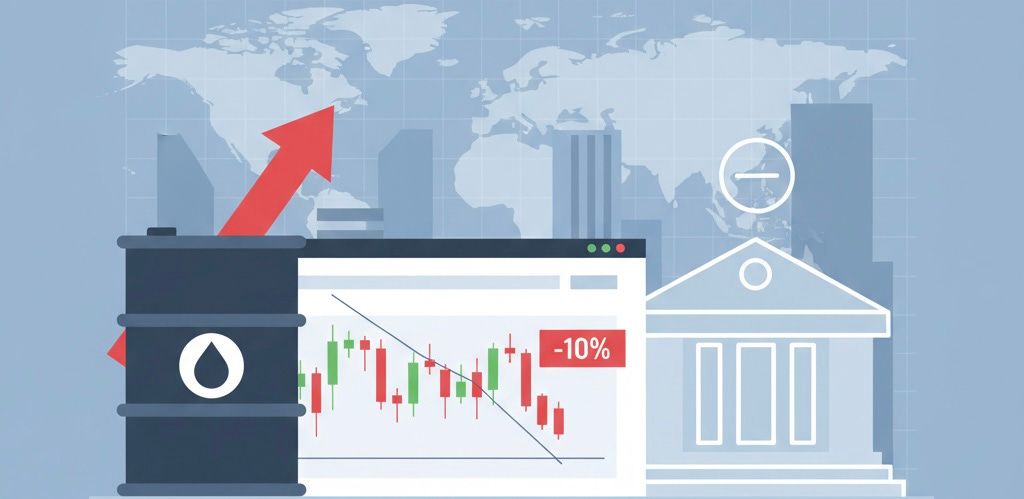
Equities spent the week grinding lower as investors tried to juggle three big forces at once: a grinding war in Iran, a near-vertical move in oil, and a Federal Reserve that isn’t in a hurry to cut rates.
The result: major US indices are down roughly 10% from recent highs, small caps are already in correction, and volatility has crept meaningfully higher.
📉 What’s Happening
Indices are flirting with correction.
The S&P 500 fell about 1.9% this week to around 6,506, its lowest close since September and roughly 10% below its record from four months ago.
The Dow dropped about 2.1% (roughly 981 points) to 45,577, while the Nasdaq also lost about 2.1% and sits roughly 9.7% off its high.Small caps have already cracked.
The Russell 2000 has officially entered correction territory, dropping more than 10% from its recent peak as investors dump economically sensitive names.War-driven oil shock is back in the driver’s seat.
Brent crude is up nearly 50% since the Iran conflict began, recently trading above 114–115 a barrel after fresh strikes on Gulf energy infrastructure and effective closure of key shipping lanes.
The International Energy Agency has called this the worst oil supply disruption in history, as the Strait of Hormuz bottleneck strands a big chunk of Middle East output.The Fed stayed put – and signaled just one cut.
The Federal Reserve kept its benchmark rate unchanged at 3.5–3.75% in an 11–1 vote, citing sticky inflation and only slightly softer growth.
Its latest projections (the “dot plot”) now imply just one rate cut in 2026, tempering hopes for a faster easing cycle that markets had been pricing in before the oil spike.Market internals have deteriorated fast.
The S&P 500 has now closed below its 200‑day moving average for the first time since last May, a sign that the uptrend has cracked.
Only about 18% of S&P 500 stocks are above their 50‑day moving average, and hedge funds dumped an estimated 9.6 billion dollars of US equities in a single day this week – the largest net selling since at least 2022.Volatility is elevated, but not at panic levels.
The VIX futures curve for late‑March shows roughly a 27% jump over the past month, keeping implied volatility above the “complacent” teens but still far from crisis highs.Single‑stock stories are adding pressure, especially in tech.
AI bellwether Micron fell nearly 4% after guidance failed to live up to lofty expectations, contributing to a broader drag in megacap tech and AI‑linked names.
🤔 Why It Matters
1. War + oil spike = renewed inflation risk.
A near‑50% surge in crude since the start of hostilities raises the odds of a second inflation wave via higher fuel and transport costs, just as central banks were hoping they were past the worst.
If energy stays above 100 a barrel for long, it can erode consumer spending power and squeeze corporate margins, forcing the Fed and peers to keep policy tighter for longer.
2. The Fed is boxed in – and markets hate the message.
By holding rates steady and penciling in only one cut this year, the Fed effectively said: “We see risks from inflation and growth in both directions – so we wait.”
Equity investors had been betting on multiple cuts; repricing to a slower path helps explain why rate‑sensitive growth stocks and small caps are underperforming, while defensive sectors see relatively better support.
3. This is behaving like a textbook correction, not (yet) a crisis.
US stocks are down just over 10% from their early‑2026 highs, which technically puts the broad market into correction, but still well short of a 20% bear market.
Strategists like Ed Yardeni see the Iran war driving a 10–15% pullback – painful but historically normal, and potentially a reset of stretched valuations after the S&P started the year trading around 22 times forward earnings.
4. Positioning has flipped from “buy the dip” to “get me out.”
Earlier in the year, every wobble was met with aggressive dip‑buying at key moving averages; now, flows show systematic and hedge‑fund sellers dominating, and “buy‑the‑dip” demand showing up later and more cautiously.
That shift in psychology can deepen short‑term drawdowns, but it also means a lot of de‑risking has already happened – setting up more asymmetric upside once macro headlines stabilize.
💡 Opportunities
1. Energy and quality defensives are built for this tape.
With oil up nearly 50% since the conflict began and energy infrastructure under threat, integrated oil majors, refiners, and select oil‑service names are obvious beneficiaries and have already started to outperform broader indices.
Goldman Sachs notes that while markets will likely weather the conflict, rising energy costs are a real headwind, and suggests investors tilt toward energy, quality value, and defensive sectors that can pass on inflation.
2. Corrections in high‑quality growth can be entry points – not exit points.
The Morningstar US Market Index and S&P 500 have both dropped more than 10% from peaks, with technology leading the decline after an extended AI‑driven run.
For investors with multi‑year horizons, staggering entries into cash‑rich, structurally growing companies during 10–15% drawdowns has historically delivered strong forward returns – provided earnings hold up.
3. Global diversification still matters.
While US markets have corrected, they remain underpinned by AI infrastructure spending, resilient earnings, and the prospect of eventual rate cuts in the second half of 2026.
Regions directly exposed to oil exporters and the Middle East corridor (for example, some GCC and European markets) face a different mix of risks and opportunities, which argues for a diversified, global equity allocation rather than a single‑market bet.
4. Stay disciplined on risk management.
With volatility higher and news‑flow binary, tools like position sizing, staggered buying, and predefined stop‑loss or hedge levels matter more than macro guessing.
Professional flows show hedge funds already slashing risk; for individual investors, the key edge is usually time horizon and discipline, not speed.
✅ Bottom Line
The market is digesting a three‑way shock: a grinding war in Iran, the sharpest oil spike in years, and a Fed that’s in no rush to ease.
That mix has pushed US stocks into correction territory, cracked key technical supports, and flipped sentiment from “buy the dip” to “sell the rip.”
But history suggests corrections driven by external shocks and valuation resets often become opportunities, not the start of a structural bear market – especially when earnings remain resilient and central banks still have room to cut later.
Disclaimer: This article constitutes the author’s personal views and is for entertainment and educational purposes only. It is not to be construed as financial advice in any form. Please do your own research and seek advice from a qualified financial advisor. From time to time, I have positions in all or some of the mentioned stocks when publishing this article. This is a disclosure - not a recommendation to buy or sell stocks.