
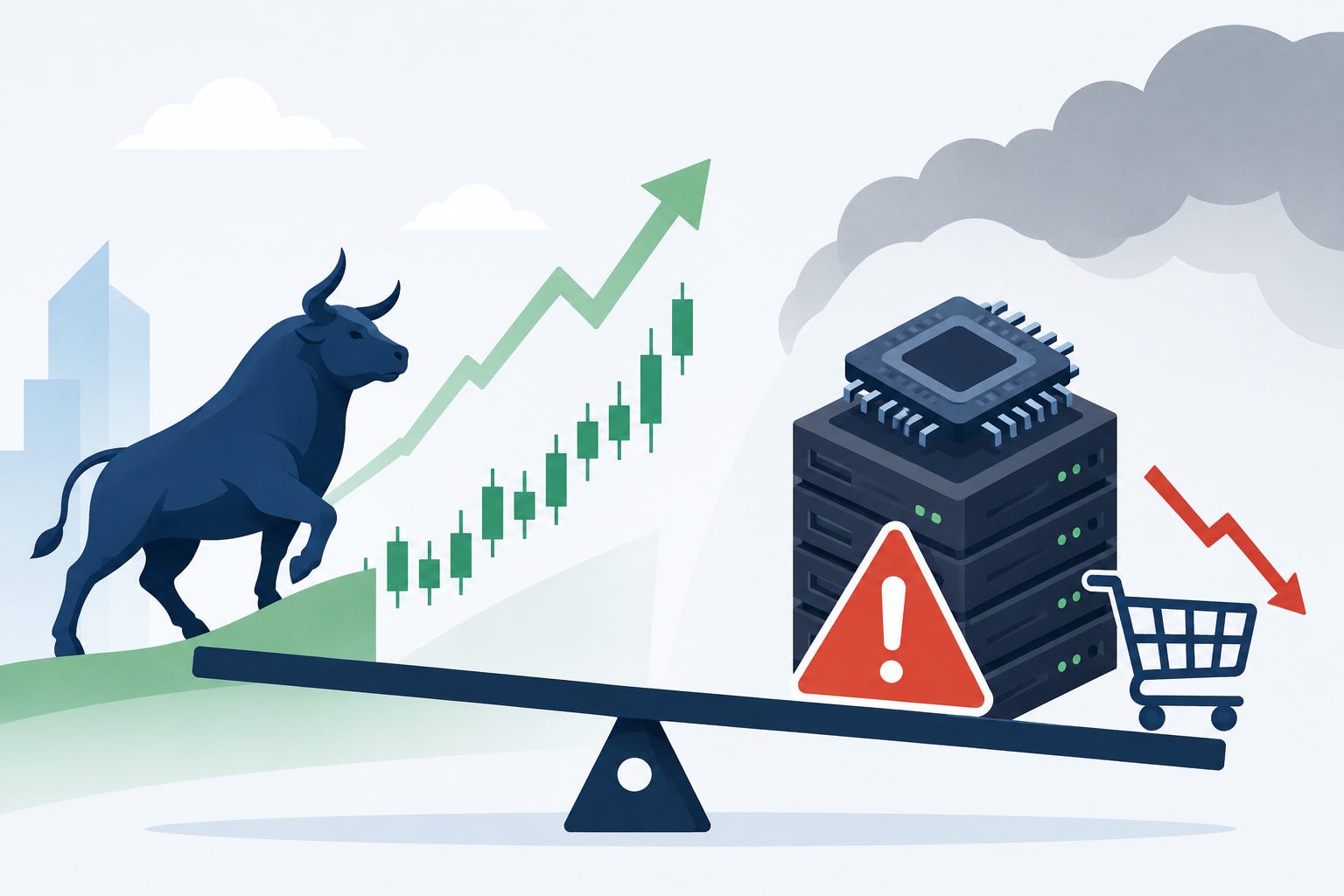
Markets did something a bit contradictory this week: stocks closed out a third straight winning week and touched fresh record highs, and yet Friday still felt jumpy. The S&P 500 punched above 7,800 for the first time on Thursday. The Russell 2000, home to smaller companies, hit its own all-time high the next day. But look past the headlines and there’s real tension underneath: cooling inflation on one side, a wobble in how Big Tech is actually paying for its AI buildout on the other. Here’s what happened, and what it means for your money.
Our August US picks have been strong, returning 17% month-till-date. Check it out here.
📊 What’s happening
Let’s start with the good news. July’s inflation report came in cooler than feared. Headline CPI rose just 0.1% for the month, pulling the annual rate down to 3.4% from June’s 3.5%. Core inflation, which strips out food and energy, held at 2.5% year-over-year. That’s still above the Fed’s 2% target, but it was calm enough to ease worries that the central bank would need to stay tough for longer. Traders are now leaning toward the Fed holding steady rather than tightening again next month.
That relief helped push the S&P 500 to its record close above 7,800 on Thursday. The index still finished the week roughly 0.65% higher overall, even after slipping back on Friday. Small-cap stocks actually had the better week: the Russell 2000 hit an all-time high, a sign investors think this rally has room to broaden out beyond the usual handful of tech giants.
Then came Friday’s reality check. Retail sales fell 0.6% in July, a sharp miss against expectations for a small gain, and consumer confidence slipped too. That’s the kind of number that makes you wonder whether households are starting to pull back on spending.
And the week’s real flashpoint came from Broadcom, which dropped nearly 6% after Bank of America flagged that the company’s AI chip financing arrangement could balloon to $370 billion in debt by 2029. Broadcom doesn’t carry that debt directly. It sits in a separate financing vehicle that leases AI chips to customers, with Broadcom on the hook as a backstop if those customers can’t pay. It’s the kind of structure that sounds fine right up until it doesn’t. AMD had a much better week by comparison, climbing on an analyst’s Street-high price target for its AI chip business.
A few other things worth knowing: Reddit jumped double digits after news it’s joining the S&P 500 next week. Nu Holdings, the Brazilian digital bank, popped after posting its first-ever $1 billion quarterly profit. And oil prices, which spiked earlier in the week on tensions around the Strait of Hormuz, kept energy stocks as the week’s best-performing sector.
🤔 Why it matters
Here’s the tension worth sitting with. The market is pricing in a fairly rosy outcome: inflation cooling gently, the Fed staying patient, and AI spending continuing to drive earnings higher. But two things this week hint at cracks in that story.
First, the Broadcom news is a reminder that the AI boom isn’t just being funded out of company cash piles anymore. It’s increasingly built on complex, leveraged financing arrangements that sit just off the main balance sheet. That’s not automatically a crisis. It does mean the AI trade now carries a financing-risk layer that barely existed a year or two ago, and investors are only just starting to price it in.
Second, weak retail sales paired with a shaky consumer is exactly the kind of thing that can turn a smooth “soft landing” story into something bumpier. Add to that the 30-year Treasury yield hitting its highest level in 25 years this week, and you’ve got pressure from two directions at once: less spending power for shoppers, and pricier long-term borrowing for companies trying to fund growth. Neither is an emergency by itself. Together, they’re worth watching.
💡 Opportunity
None of this means it’s time to go defensive or sit out the rally. Records happen because earnings and macro data have actually been decent, not because the market is broken. Still, this week’s news points to a few sensible moves.
If you own AI-adjacent stocks, it’s worth understanding how their AI spending is actually financed, not just how big the revenue number looks. Companies funding their buildout through vendor financing and off-balance-sheet vehicles, like Broadcom’s arrangement, carry a different risk profile than ones paying with straightforward free cash flow. That doesn’t mean avoid them. It means know what you actually own.
The small-cap rally deserves a look too. Russell 2000 companies tend to be more domestically focused and more sensitive to rate expectations, so a fresh record there suggests investors really do think rate relief is on the way, not just that a few AI giants are propping up the index on their own. If your portfolio has been entirely parked in mega-cap tech, this could be a decent moment to think about diversifying into that broader move, rather than chasing it after it’s already run.
And if the consumer story has you nervous, lean toward companies with pricing power and steady demand over discretionary, big-ticket names. Weak retail sales don’t hit every sector the same way. Staples and healthcare tend to hold up better than travel or big discretionary purchases when shoppers get cautious.
🎯 Bottom line
Stocks are at records, inflation is cooling, and that’s genuinely good news. But this was also the week the AI trade’s financing plumbing started making headlines, and the consumer showed its first real signs of fatigue in a while. You don’t need to overreact to either one. You do need to keep both in view, because a market this calm on the surface can turn quickly once the story underneath it stops matching the price on the screen.
Disclaimer: This article constitutes the author’s personal views and is for entertainment and educational purposes only. It is not to be construed as financial advice in any form. Please do your own research and seek advice from a qualified financial advisor. From time to time, I have positions in all or some of the mentioned stocks when publishing this article. This is a disclosure - not a recommendation to buy or sell stocks.