
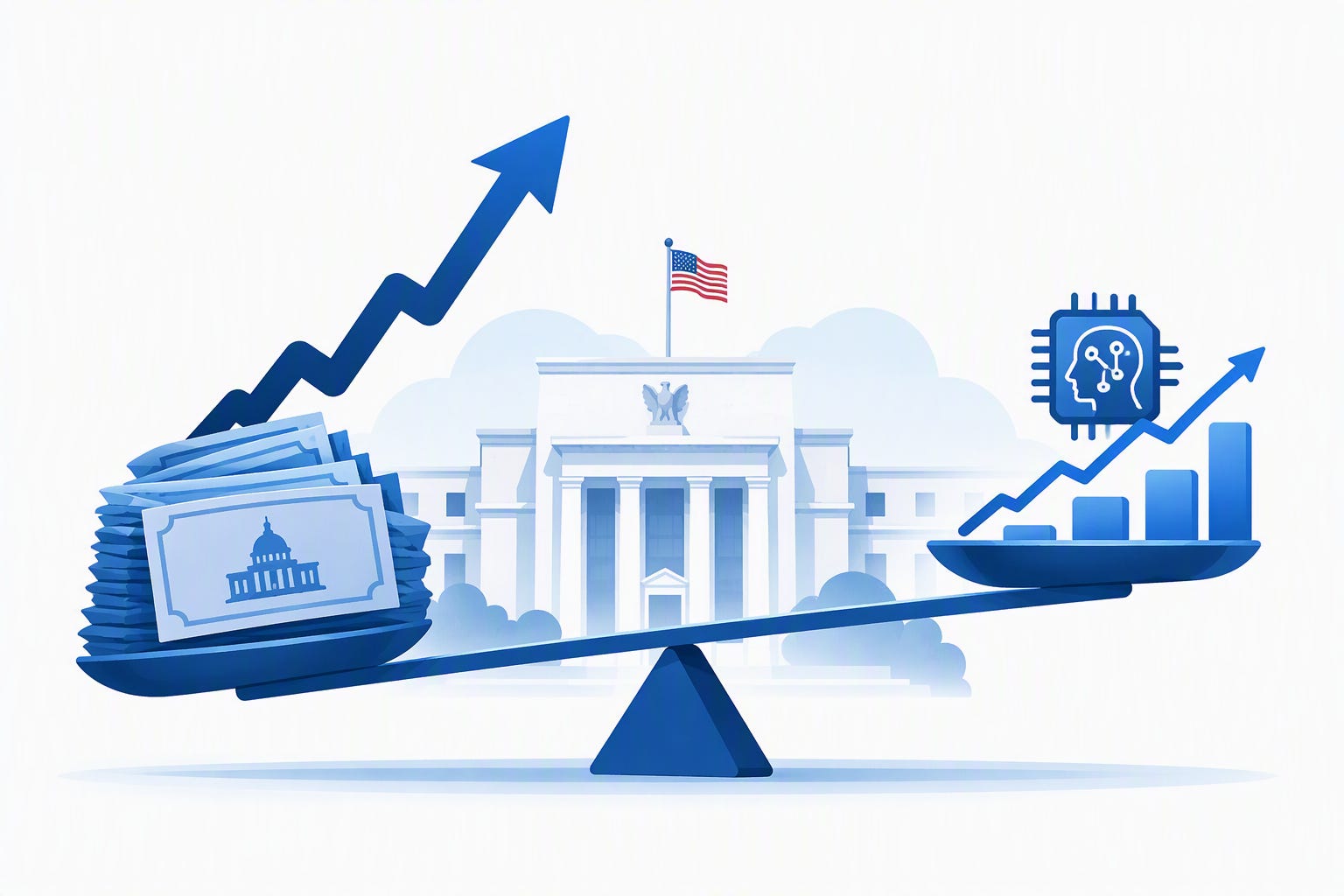
The 10-year Treasury yield spent this week climbing to levels we haven’t seen since 2007, and the 30-year hit a mark last touched back in 2004. That’s the kind of move that usually sends stocks running for cover. Instead, the S&P 500 just notched its first winning week in three and sits close to the record high it set last month.
Meta had one of its best weeks in years thanks to an AI assistant that’s apparently more popular than ChatGPT right now. Costco pulled in nearly $94 billion in quarterly sales. Oil prices actually fell. It was a strange, split-personality week: bond investors are nervous, stock investors are not, and somehow both of them are looking at the same headlines. Here’s what actually happened, and why the bond market might be telling you something the stock market isn’t ready to hear yet.
📊 What’s happening
Let’s start with the thing that mattered most this week: bonds got hammered, and yields went up hard. The 10-year Treasury yield climbed to roughly 5.2%, its highest level since 2007. The 30-year went even further, touching 5.44%, a mark it hasn’t hit since 2004. That’s the government’s own borrowing cost, and when it rises this fast, it drags almost every other interest rate up with it.
Why the sudden spike? A few things piled up at once. Business activity surveys showed the economy running hot in September, which sounds like good news until you realize it also gives inflation more fuel. A University of Michigan survey found consumers now expect inflation to run at 4.6% over the next year, up from 4% just a month earlier. A recent Treasury auction also came in weak, meaning the government had to offer higher yields just to find buyers. Add it up, and traders are now pricing in better-than-even odds the Fed hikes rates again at both its October and December meetings, on the heels of the increase it just delivered last week.
Here’s the part that should’ve spooked the stock market and mostly didn’t. The S&P 500 gained roughly 2% this week, its best stretch in almost a month, and it’s still hovering near the all-time high it hit in August. The Nasdaq did even better, up around 2.3%, and the Dow rallied hard on Friday, jumping more than 470 points in a single session. Chipmakers led the charge, with Nvidia, Broadcom, and Micron all climbing as the semiconductor ETFs SMH and SOXX each rose about 1.4%.
A big piece of that strength has a name: Muse. Meta launched its new AI assistant on September 8th, and it’s since racked up 2.5 million downloads and briefly knocked ChatGPT off the top of the app store charts. Meta’s stock jumped as much as 11% in a single day on the news and is up something like 36% since launch. The app books tickets, handles shopping, and answers messages, but the real prize for Meta isn’t the subscription fee. It’s the data. Every time you tell Muse what you want to buy, Meta learns something it can sell to advertisers, and against $227 billion in annual ad revenue, even a tiny improvement there adds up to billions.
Costco also reported earnings this week, and the headline numbers looked great: $93.9 billion in quarterly revenue, up 11.2%, and earnings per share of $6.75, beating estimates. Dig one layer down, though, and about $0.15 of that per-share number came from a one-time tariff refund, so the underlying growth was closer to 12% than the 15% the headline suggested. The stock barely moved on the news. Investors also noticed the company’s membership renewal rate slipped slightly to 89.8%, which matters because membership fees make up roughly two-thirds of Costco’s profit.
Elsewhere, oil prices actually eased this week, with U.S. crude falling to around $92 a barrel, after Iran floated a proposal aimed at de-escalating tensions that have kept the region on edge. Chinese President Xi Jinping made a state visit to the White House, with a dinner that reportedly included Nvidia’s Jensen Huang and Elon Musk among the guests, a small but symbolic sign that trade tensions might be cooling a notch.
🤔 Why it matters
The bond story is the one to actually pay attention to, even if stocks aren’t panicking about it yet. When long-term yields rise this fast, borrowing gets more expensive for everyone, not just the government. Average 30-year mortgage rates have already pushed back above 7%, and business loans are getting pricier too. That’s a slow-moving squeeze, but it’s a real one.
It also puts the Fed in an awkward spot. It just raised rates last week to fight inflation, and the bond market is essentially saying that wasn’t enough. Rising inflation expectations are tricky because they can become self-fulfilling: if people believe prices are going up, they buy sooner rather than later, which pushes prices up faster, which confirms the fear. That’s the loop the Fed is trying to break, and this week’s data suggests it hasn’t yet.
So why are stocks fine with all this? Mostly because earnings are still strong enough to offset the higher-rate pain, at least for now. As one analyst put it this week, corporate profits are holding up the market’s floor, while policy and geopolitical noise are building its ceiling. Meta’s Muse launch is a genuine, fresh growth story in a market that’s been hunting for one beyond the usual AI infrastructure names. Costco’s numbers, tariff refund aside, still show a consumer that’s spending. Chipmakers rallying tells you the AI trade isn’t dead. But valuations for a lot of these names are stretched, and higher yields make expensive stocks more vulnerable, since investors can now get a safer 5%-plus return just from holding a Treasury bond.
💡 Opportunity
If you’re carrying a variable-rate loan or eyeing a big purchase on credit, this week’s yield spike is a nudge to act rather than wait. Rates aren’t dropping anytime soon if the bond market’s current mood holds, and every month you wait for “lower rates” is a month you’re paying today’s higher ones.
If you’re a saver, though, this is actually a decent moment. With short-term yields still elevated and some savings accounts and CDs paying north of 4%, parking cash you don’t need right away isn’t the worst move while everyone else argues over where rates go next.
Watch how AI-adjacent stocks handle higher yields from here. Meta’s Muse story is a reminder that real product traction, not just spending announcements, can still move a stock double digits in a day. But richly valued names, Costco at roughly 40 times forward earnings is a good example, need more than a decent quarter to justify the price tag. A beat that’s partly a one-time item won’t cut it.
Keep an eye on oil and diesel if you’re exposed to transportation, shipping, or retail margins. This week’s dip on Iran diplomacy news was welcome, but that story has swung both ways all year, and a reversal would hit everyday costs before you’d notice it in the headlines.
🎯 Bottom line
The real story this week wasn’t the stock market’s gains, it was the bond market’s warning. Treasury yields at levels last seen in 2007 and 2004 are the market’s way of saying it’s not convinced last week’s rate hike solved the inflation problem, and it’s pricing in more hikes to come. Stocks found a way to shrug that off this week, helped by a genuinely exciting product launch at Meta, solid if slightly padded numbers from Costco, and a welcome break in oil prices. That combination can hold for a while. It can’t hold forever if yields keep climbing at this pace. Keep your eyes on the 10-year more than the S&P 500 over the next few weeks. It’s telling you more about where things are headed.
Disclaimer: This article constitutes the author’s personal views and is for entertainment and educational purposes only. It is not to be construed as financial advice in any form. Please do your own research and seek advice from a qualified financial advisor. From time to time, I have positions in all or some of the mentioned stocks when publishing this article. This is a disclosure - not a recommendation to buy or sell stocks.