
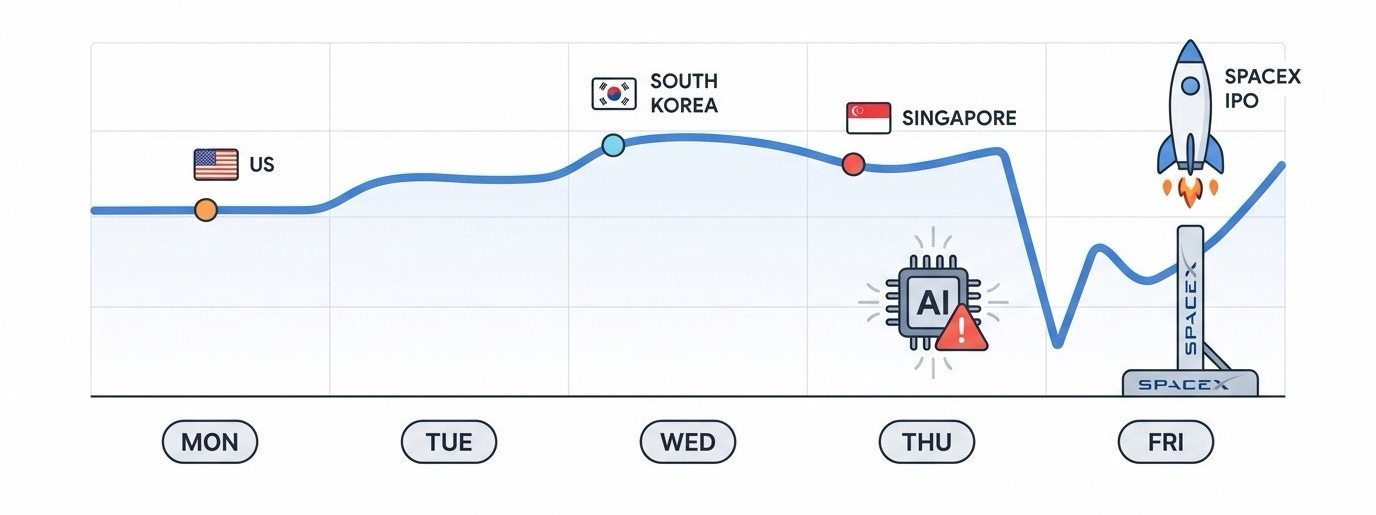
Global equities just had a classic “AI hangover” week: megacap tech and chips sold off hard on a hotter‑than‑expected US jobs report, South Korea’s KOSPI hit circuit breakers, and yet tech snapped back almost immediately as traders bought the dip. At the same time, the market is bracing for the record‑breaking SpaceX IPO at around a $1.7T+ valuation, which could become the defining sentiment event for growth stocks this month.
📉 What’s happening
US: hot jobs, cold AI trade (for a day)
The US added about 172k jobs in May, roughly double the 85k consensus, with unemployment steady at 4.3%, reinforcing the “resilient economy” narrative and pushing Fed hike expectations higher.
That print triggered a brutal Friday risk‑off move: the S&P 500 dropped about 2.6%, while the Nasdaq fell over 4%, its worst one‑day decline in more than a year as investors dumped AI and megacap tech.
For the week, the Nasdaq 100 was down roughly 4.5%, the S&P 500 about 2.4%, and the small‑cap Russell 2000 nearly 4%, ending a powerful multi‑week run‑up.
Then, a fast tech rebound
By Monday, “buy the dip” was back: the Nasdaq rose about 0.9%, the S&P 500 gained roughly 0.3%, and the PHLX Semiconductor Index jumped 5–6% as beaten‑up AI names bounced.
Intel surged more than 10–12% on reports of a major AI‑chip manufacturing deal with Google, while other AI beneficiaries such as Marvell and Corning also rallied on index inclusion and cloud‑data‑center contract news.
Asia: Korea wears the pain, Singapore holds up
South Korea’s KOSPI plunged about 8.3–8.4% on Monday, triggering circuit breakers, with heavy selling in AI bellwethers Samsung Electronics and SK Hynix that had previously driven the index’s stellar run.
Despite the crash, the KOSPI is still up more than 70%+ year‑to‑date after a 76% gain last year, underlining just how extended the market had become before this correction.
Foreign investors have been net sellers of Korean equities for months, dumping around 62 billion dollars‑equivalent in stocks by late May, and offloading another 1.24 trillion won on Monday alone.
In contrast, Singapore’s Straits Times Index has been comparatively calm, with recent data showing a modest positive move of around 1% over the last five days, supported by banks and blue‑chips.
Geopolitics and oil in the background
Tensions between Iran and Israel briefly pushed oil up around 3%, but prices eased after President Donald Trump signalled both sides were aiming for an “immediate ceasefire,” cooling some inflation fears.
US Treasury markets still reacted to the strong jobs print: 10‑year yields climbed into the 4.53–4.55% range, with 2‑year yields around 4.18%, a classic “higher‑for‑longer” rates move.
SpaceX: the monster IPO
SpaceX is expected to list on Nasdaq around 12 June at about $135 per share, raising roughly $75B and implying a valuation near $1.75–1.77T—the largest IPO in history and far above any prior US listing.
At that price, SpaceX would be trading at a huge price‑to‑sales multiple on roughly $18.7B of 2025 revenue, and some analysts estimate it would need to reach around $1.1T in revenue by 2035 (50%+ annual growth) to justify the valuation.
🤔 Why it matters
AI is still the core equity narrative – but expectations are stretched
The violent swing—from AI euphoria to a one‑day tech rout and back to a brisk bounce—shows how crowded AI trades have become; small changes in macro data now trigger outsized price moves.
With forward S&P 500 P/E at about 21×, near or above 5‑ and 10‑year averages, any upside surprise in inflation or jobs quickly feeds rate fears and compresses multiples, particularly in long‑duration growth and semis.
Korea is a warning shot for overheating AI proxies
The KOSPI’s 8%+ one‑day drop despite still‑massive YTD gains is a live case study of what happens when a national index is effectively a leveraged bet on a single theme—in this case, AI chips.
For investors across Asia, it’s a reminder that index‑level exposure is not the same as diversification when a handful of AI names dominate weightings and flows.
SpaceX could reset risk appetite
A successful $1.7T‑ish SpaceX IPO could cement the idea that we’re in a full‑blown “AI + space + frontier tech” cycle, encouraging more jumbo offerings (Anthropic, OpenAI etc.) and reinforcing high‑beta sentiment.
Conversely, any stumble in pricing or early trading would be a powerful reality check on ultra‑rich growth valuations and might spill over into listed AI leaders that have been re‑rated on similar narratives.
Rates and oil are the macro swing factors
With US 10‑year yields back above 4.5% and the dollar stronger, equity investors are again having to balance AI optimism against a higher discount rate, which is traditionally toxic for long‑duration growth.
Middle East risks keeping oil near elevated levels mean that even if the immediate spike fades, the market will stay hypersensitive to any CPI prints that show energy‑driven upside.
📈 Where’s the opportunity
Not investment advice; this is a roadmap for where a data‑driven investor might focus their screens this week.
Quality AI and chips – but only on your terms
The combo of a 4–5% weekly drawdown in US tech indices and a 5–6% single‑day bounce in semis is exactly the kind of volatility that options sellers and patient stock pickers can exploit.
For long‑only portfolios, a rules‑based approach—e.g., only adding to high‑ROIC, cash‑generative AI names when they fall a pre‑defined percentage from 50‑ or 100‑day moving averages—helps avoid chasing intraday reversals.
South Korea: from momentum darling to tactical trade
With the KOSPI still massively up year‑to‑date even after an 8% crash, broad‑market exposure remains high‑beta and policy‑sensitive.
If you’re comfortable with volatility, narrow, staggered entries into top‑tier chipmakers or KOSPI ETFs after large down days (rather than blindly buying the index) may offer better risk‑adjusted upside, particularly if US yields stabilise.
Singapore: use local defensives as ballast
The STI’s relative stability vs. the violent swings in US and Korean tech reiterates its role as a “spine” asset for regional investors—dominated by banks, REITs and key blue‑chips.
Pairing global AI exposure with Singapore banks/REITs can reduce portfolio volatility while still participating in structural themes like digitalisation and ASEAN growth.
SpaceX: consider second‑order plays, not just the IPO
Given the record‑high valuation, huge hype, and retail interest, the risk of post‑IPO whipsaws in SpaceX is significant.
Instead of trying to game day‑one price action, look at “picks and shovels”—listed suppliers (launch, satellite, ground infrastructure) and space/defence ETFs that may re‑rate as the space ecosystem gets repriced, without single‑name IPO risk.
🧭 Bottom line
This week’s message from markets is simple: AI is still the main story, but the macro backdrop (jobs, yields, oil) can overpower the narrative on any given day.
Treat the SpaceX IPO and the KOSPI shock as stress tests for how your portfolio handles crowded themes and valuation extremes, and rebalance toward quality, diversification, and rules‑based entries rather than headlines.
Disclaimer: This article constitutes the author’s personal views and is for entertainment and educational purposes only. It is not to be construed as financial advice in any form. Please do your own research and seek advice from a qualified financial advisor. From time to time, I have positions in all or some of the mentioned stocks when publishing this article. This is a disclosure - not a recommendation to buy or sell stocks.