
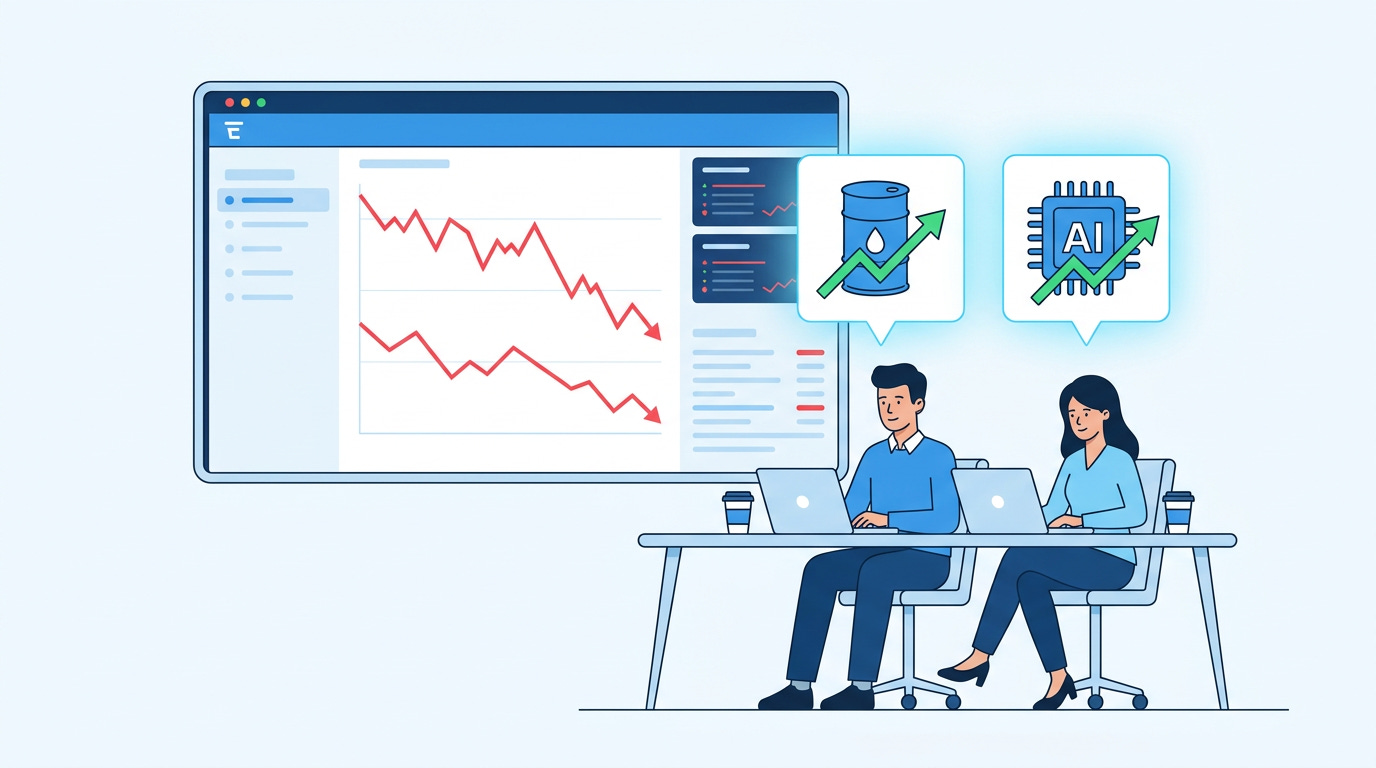
This week, markets were hit by a rare combo of an oil price shock, a weak US jobs report, and renewed questions around AI spending.
US stocks swung violently and ultimately finished the week lower, even as AI heavyweight Broadcom delivered standout earnings.
📈 What’s happening
Oil went vertical on Iran war fears.
After US and Israeli strikes on Iran, crude spiked, with US oil ending the week around 90.90 dollars and Brent 92.69 dollars, marking the biggest weekly gain on record and a roughly 36% jump in just one week.
Earlier in the week, oil had already surged 7–9% on headlines about disrupted traffic through the Strait of Hormuz.Stocks sold off into the weekend.
The S&P 500 fell from 6,878.88 at the prior Friday’s close (Feb 27) to about 6,769.03 by March 6, a drop of roughly 1.6% for the week.
On Friday alone, the Dow dropped 453 points (~0.9%), the S&P 500 fell 1.3%, and the Nasdaq slid 1.6%.A surprisingly weak US jobs report rattled investors.
The US economy lost 92,000 jobs in February, versus expectations for a gain of about 50,000, and the unemployment rate ticked up to 4.4% from 4.3%.
Treasury yields fell after the data, with the 10‑year drifting toward 4.13%, as traders reassessed growth and Fed-cut timing.Fear rotated money into defensives, energy, and defense.
Airlines and travel names were among the hardest hit as higher fuel costs and Middle East disruption weighed on sentiment.
By contrast, oil majors and defense contractors saw renewed interest as higher crude prices and geopolitical risk supported their earnings outlooks.Broadcom was the standout single-stock story.
Broadcom reported Q1 revenue of 19.31 billion dollars, up 29% year-on-year, and non‑GAAP EPS of 2.05 dollars, beating analyst estimates.
Management guided for 22 billion dollars of Q2 revenue (up 47% YoY) and highlighted that AI semiconductor revenue more than doubled year-on-year to 8.4 billion dollars, sending the stock up about 5% in after-hours and subsequent trading.
🤔 Why it matters
Oil shock + weak jobs = stagflation worries.
A sudden 30%+ weekly move in oil raises the risk that inflation re-accelerates just as growth data softens, a classic stagflation scare.
That combination makes the Fed’s job harder: cutting rates too quickly risks reigniting inflation, but staying tight into weaker labor data risks a sharper slowdown.Market leadership is getting stress-tested.
Before this week, the S&P 500 was only modestly positive for 2026 (around 0.5% year‑to‑date as of Feb 27), leaving little cushion against shocks.
The latest pullback, led by growth and tech names, shows how quickly sentiment can turn when investors question AI capex, export risks, and stretched valuations.Yet AI infrastructure demand still looks structurally strong.
Broadcom’s 29% revenue growth and booming AI chip sales suggest that hyperscaler spending on AI hardware remains robust, even as public-market enthusiasm cools.
That divergence—volatile AI stock prices vs. strong AI fundamentals—is likely to keep dispersion high within the tech sector.Volatility itself is now a key macro variable.
The VIX spiked to around 23.75, reflecting a jump in demand for downside protection and signaling that investors are bracing for larger daily swings.
Elevated volatility tends to compress valuation multiples and reward balance-sheet strength, consistent cash flows, and “sleep‑at‑night” characteristics.
💡 Opportunity
Energy: pricing power, but don’t chase every spike.
Integrated oil and gas producers stand to benefit directly from higher realized prices and stronger cash flow, especially after a record weekly move in crude.
However, if diplomacy cools tensions and shipping normalizes in the Strait of Hormuz, some of this risk premium can unwind quickly—favor phased entries and quality balance sheets over short‑term trades.Defense: geopolitical risk as a structural tailwind.
With the Iran conflict adding to an already elevated global risk backdrop, defense spending looks more likely to rise than fall over the medium term, supporting order books at major contractors.
For long-term investors, the key is not the headline of the week, but multi‑year budget trajectories and contract visibility.Quality income stocks in the crossfire.
Broad-market de‑risking often pulls down high‑quality dividend payers alongside more speculative names, even if their fundamentals are more resilient.
This kind of tape can create opportunities to accumulate strong free‑cash‑flow, pricing‑power businesses at more reasonable multiples as investors rush for the exit indiscriminately.Using higher volatility to get paid.
With the VIX in the 20s, option premiums on broad indices and liquid large caps are richer, improving the risk/reward for covered calls and cash‑secured puts—provided position sizing and margin are handled conservatively.
Income‑oriented investors can lean into selling volatility on names they’re happy to own long term, instead of trying to time short‑term macro headlines.AI enablers over AI hype.
Broadcom’s print reinforces the case for picks‑and‑shovels AI winners—chipmakers and infrastructure providers with clear revenue visibility—versus more speculative application-layer stories.
Pullbacks driven by macro fear rather than company-specific deterioration can be an entry point into profitable AI infrastructure names with disciplined capital allocation.
📌 Bottom line
This week was all about an energy shock colliding with softer growth data, forcing markets to rapidly reprice the path for inflation, rates, and earnings.
For investors, the playbook is less about predicting the next headline from the Middle East and more about positioning for higher‑for‑longer volatility—with quality balance sheets, durable cash flows, and selective exposure to structural themes like AI and energy at the core.
Disclaimer: This article constitutes the author’s personal views and is for entertainment and educational purposes only. It is not to be construed as financial advice in any form. Please do your own research and seek advice from a qualified financial advisor. From time to time, I have positions in all or some of the mentioned stocks when publishing this article. This is a disclosure - not a recommendation to buy or sell stocks.