
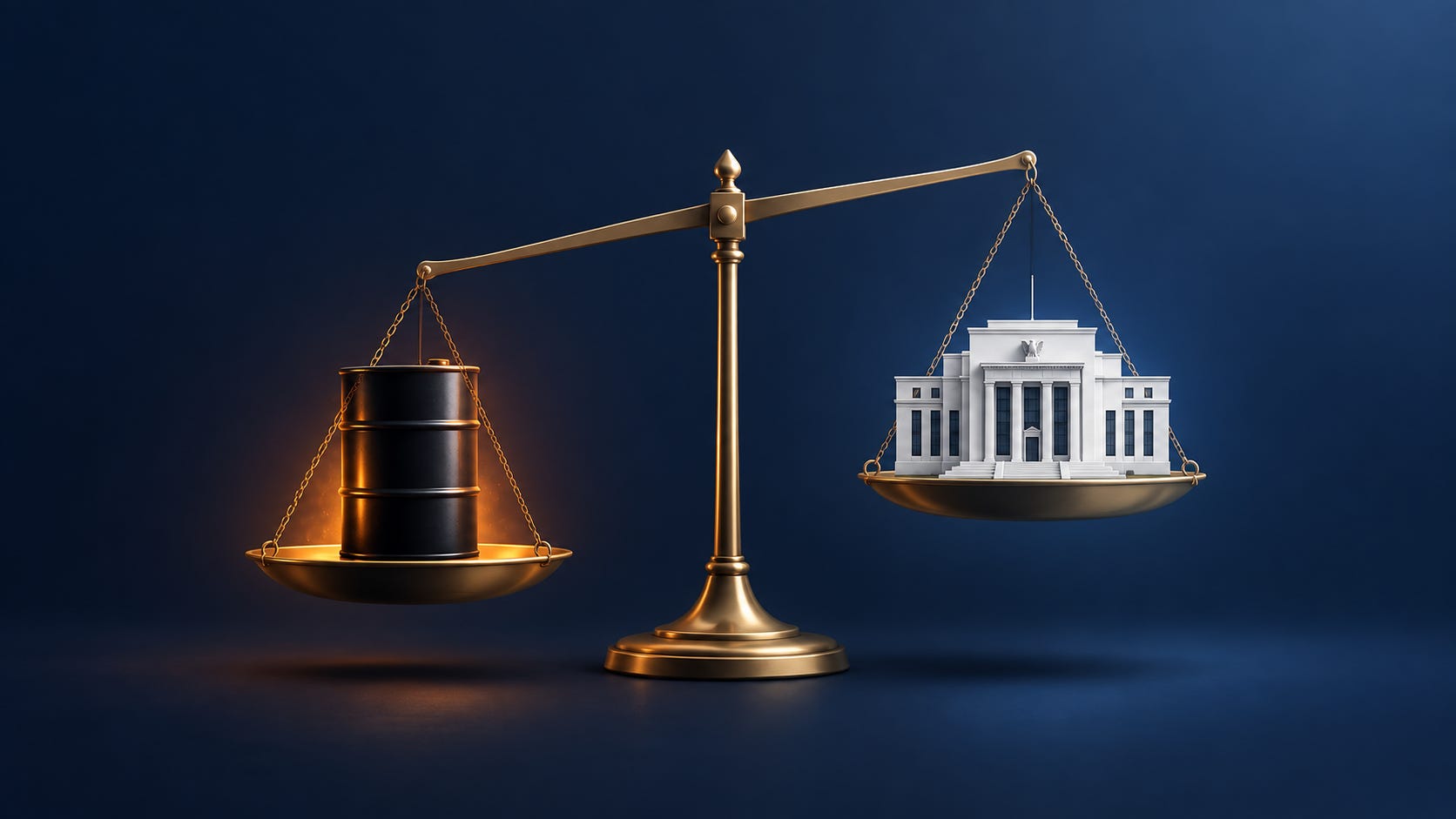
A few weeks ago, the big question on Wall Street was simple: will the Fed cut rates in September, or just hold steady? Nobody was seriously talking about a hike. This week, that conversation basically got hijacked. Oil blew past $100 a barrel for the first time since July, gas prices jumped overnight, and diesel hit a record high. By Thursday, traders had priced in a real chance the Fed goes the other way entirely and raises rates instead. Then Friday’s inflation report landed almost exactly as expected, oil cooled off a touch, and stocks had their best day in weeks. It was a lot to pack into five trading days. Here’s what actually happened, and why an oil story turned into a Fed story so fast.
📊 What’s happening
The week’s real trigger wasn’t in a spreadsheet. It was in the Middle East. The US and Iran have been locked in an escalating standoff for months now, mostly playing out as attacks on tankers and energy infrastructure rather than open war. This week it got worse: Iran-backed Houthi forces struck Saudi energy facilities, and US forces hit several Iranian tankers in response to an attempted missile attack on a Navy warship. Brent crude jumped from under $98 a barrel on Tuesday to above $106 by Thursday, its highest level since July. West Texas Intermediate followed it up. At the pump, that showed up fast: gasoline rose to an average of $4.22 a gallon, more than a dollar higher than a year ago, and diesel hit an all-time high near $6. Airlines started trimming routes and raising fares as jet fuel costs climbed too.
Stocks didn’t love any of this. The S&P 500 fell for four straight days through Thursday as oil kept climbing and a hotter-than-expected producer price index added to the unease. Rate-hike odds for next week’s Fed meeting, which sat at roughly 50-50 just a week earlier, surged into the 70-90% range by the end of the week. That’s a wild swing for five trading days, and it flips a script that’s been running since late August, when the new Fed chair first spooked markets by leaning hawkish at Jackson Hole.
Then Friday arrived, and the mood shifted again, even if the underlying worry didn’t fully go away. August’s CPI report came in almost exactly as forecast: prices rose 0.4% for the month and 3.4% over the past year, matching expectations. Core inflation, which strips out food and energy, ran a shade hotter than hoped at 0.3% monthly, but not hot enough to spook anyone further. Oil eased back from its Thursday peak, and traders who’d already braced for a bad print seemed relieved it wasn’t worse. The S&P 500 gained 1.06%, the Dow jumped 1.15%, and the Nasdaq rose 0.88%, snapping the losing streak in one go. Even with the rally, the week as a whole still ended lower: the S&P finished down about 0.8%, the Dow fell 1.6%, and the Nasdaq slipped 0.7%.
Oracle helped Friday’s mood too. The company’s quarterly cloud sales jumped 121% to $7.4 billion, beating estimates, and it reignited enthusiasm for anything touching AI infrastructure. Hewlett Packard Enterprise jumped 11.6% on Friday alone, Dell rose 10% on an analyst upgrade, and networking and optical suppliers Lumentum and Ciena both had strong weeks riding the same wave. Not everyone got to join the party. CooperCompanies cratered nearly 23% after cutting its full-year outlook, Casey’s General Stores fell over 16% on weak same-store sales, FactSet dropped 14% amid worries that AI tools could eat into its research business, and Amgen lost more than 12% after a rival’s failed cardiovascular drug trial raised doubts about the whole category. Meta also launched Muse, a personal AI agent that can browse and act on your behalf, with free, $20, and $100 monthly tiers.
🤔 Why it matters
Here’s the thing about an oil-driven inflation scare: it’s a different animal from the wage-driven kind. When inflation comes from a hot labor market, the Fed can watch and wait, because it usually cools on its own as job growth slows. An oil shock doesn’t work that way. It raises the cost of almost everything at once, transportation, manufacturing, food delivery, because energy touches every supply chain. That’s exactly why gas and diesel prices jumping in a single week can move Fed odds so much faster than a slow grind in wages ever could.
It also matters that this isn’t a one-week blip. The conflict is centered partly on control of the Strait of Hormuz, a chokepoint that normally carries roughly a fifth of the world’s oil. Analysts quoted this week don’t think a resolution is likely before the US midterm elections, which means the market may need to live with this uncertainty for a while, not just trade around one headline.
Put those two things together and you get why the calculus flipped so hard. A few weeks back, the debate was about whether a cooling labor market gave the Fed room to cut. Now the debate is whether a fresh supply shock, on top of already-sticky core inflation, gives the Fed a reason to hike instead. Both stories can’t be true at once, which is exactly why next week’s meeting is a coin flip.
There’s a second thread worth pulling on too. Oracle’s cloud beat and the rally in HPE, Dell, Lumentum, and Ciena show that the AI infrastructure buildout theme we flagged a couple of weeks ago, with memory chips getting squeezed by AI data center demand, hasn’t slowed down. But it’s playing out against a backdrop where consumer-facing names like Casey’s and CooperCompanies are getting punished hard for any sign of softness. That’s a different kind of squeeze showing up on the demand side, not the supply side.
💡 Opportunity
The September 16 Fed meeting is the single most important date on your calendar right now, and it’s a coin flip. Whichever way it goes, expect a bigger market reaction than usual. A hike after months of cut talk, or a hold that disappoints the hawks who’ve been piling into rate bets all week, would both force some repricing.
If you hold anything sensitive to fuel costs, airlines, trucking, logistics, or retailers with thin margins, keep an eye on where oil settles over the next few weeks, not just this week’s headline. A brief spike that fades in a month is a very different story than $100-plus oil becoming the new normal.
The AI infrastructure trade (servers, networking gear, optical components) is still working, but it’s turning into more of a stock-picker’s game than a rising tide. Oracle’s results were solid on their own merits, and the follow-through into HPE and Dell looks like actual demand, not just sentiment. See if the next round of earnings keeps backing that up before you assume it’s a given.
And don’t overcorrect based on one Friday rally. The underlying tension, oil-driven inflation risk versus a Fed that was leaning toward cuts just weeks ago, is still unresolved. Treat this week as a reason to stay alert through the FOMC decision, not a signal to make big moves on a Friday afternoon.
🎯 Bottom line
An oil shock did what months of jobs data and inflation reports couldn’t: it put a Fed rate hike back on the table, just weeks after cuts looked like the safer bet. Despite Friday’s sharp rebound, all three major indices still finished the week lower, a reminder that one good day doesn’t erase four rough ones. The Strait of Hormuz standoff shows no sign of resolving soon, Oracle’s cloud numbers say the AI buildout is still very much alive, and a handful of consumer-facing companies just got a rough reminder that guidance cuts get punished fast in this market. Next Wednesday’s Fed decision will tell you which force wins for now, but don’t expect the oil story to wrap up neatly either way.
Disclaimer: This article constitutes the author’s personal views and is for entertainment and educational purposes only. It is not to be construed as financial advice in any form. Please do your own research and seek advice from a qualified financial advisor. From time to time, I have positions in all or some of the mentioned stocks when publishing this article. This is a disclosure - not a recommendation to buy or sell stocks.