
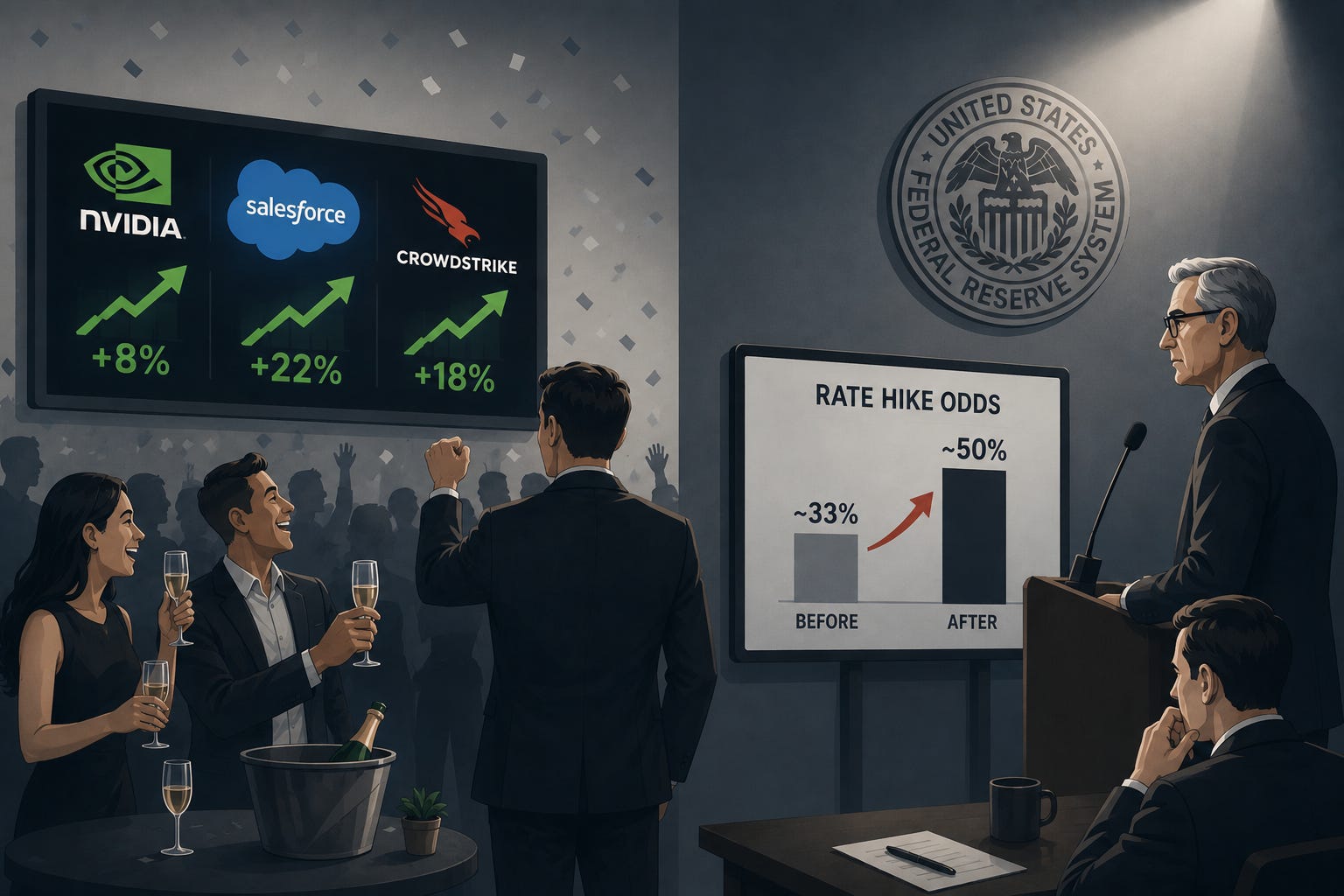
Picture the week as a party that got shut down right as it was getting good. Nvidia, Salesforce, and CrowdStrike all reported earnings Wednesday night, and the numbers were the kind that make traders spill their coffee. Thursday, stocks partied like it was 2021. Then Friday morning, the new Fed chair walked up to a podium in Wyoming and quietly turned the lights on. Nothing got canceled, exactly. But the mood in the room changed fast, and by the end of the day investors were betting on something almost nobody expected two weeks ago: a rate hike instead of a rate cut. Here’s how a genuinely great week for corporate America collided with a genuinely uncomfortable one for the Fed, and what to make of it.
📊 What’s happening
Let’s start where the week started: chip stocks getting sold. On Monday and Tuesday, Intel dropped 5%, AMD fell 4%, and Taiwan Semiconductor slipped 3%, even though nothing had actually gone wrong yet. Traders were just nervous ahead of Nvidia’s earnings, trimming positions the way you’d tidy up before guests arrive. Intel, up a wild 144% for the year, became the easiest source of cash to raise when funds needed to lighten up.
Wednesday brought the Fed’s favorite inflation gauge, and it came in a touch hotter than hoped. Core PCE held at 3.3% annually, headline PCE at 3.7%, both slightly above forecasts and both still unchanged from June. Not a disaster, but not the cooling investors were hoping to see either.
Then came the main event. After the closing bell Wednesday, Nvidia posted $96.2 billion in quarterly revenue, blowing past the $92 billion Wall Street expected, with data center sales alone hitting $89 billion. CEO Jensen Huang told analysts to expect roughly 70% revenue growth next fiscal year, well above what anyone had modeled.
Salesforce delivered its own blowout, with adjusted earnings of $5.90 a share against expectations of $3.27, and CrowdStrike posted a record $333 million in new recurring revenue and raised its full-year guidance. Thursday, the market did what markets do when three heavyweights all deliver at once: it ripped higher. Nvidia jumped 8%. Salesforce soared 22%, its best day since 2020, with CEO Marc Benioff declaring “this is not the SaaSpocalypse.” CrowdStrike gained 18%. Okta, riding the same wave, climbed 28%.
Friday, the tone flipped again. Fed Chair Kevin Warsh gave his first Jackson Hole speech since taking over in May, and instead of the market-friendly reassurance some were hoping for, he leaned hawkish. “Inflation is running above our 2% target,” he said. “So the Fed’s predominant focus right now should be on prices.” He also declined to offer any real guidance on what comes next, arguing that too much forward guidance ties the Fed’s hands. Traders didn’t love the ambiguity.
Odds of a September rate hike jumped from roughly one-in-three before the speech to just above 50-50 after it, a sharp reversal from earlier in the month, when futures markets had priced in an 83% chance of a rate cut. Stocks gave back a little ground Friday, with the S&P 500 dipping 0.12% and the Nasdaq slipping 0.34%, while bond yields moved in a “bear flattener” pattern, with short-term rates rising faster than long-term ones. For the week overall, the S&P 500 gained about 0.5%, the Nasdaq added roughly 0.9%, and the Dow rose around 0.5%, a modest headline number that hides just how much happened underneath it.
🤔 Why it matters
Here’s the tension worth sitting with. Corporate earnings and Fed policy just sent two different signals, and they can’t both be right forever. Nvidia, Salesforce, and CrowdStrike all told you that demand for AI software and infrastructure is still accelerating, not slowing down. That’s a real, fundamental story about real revenue and real customers, not hype. But that same AI enthusiasm has pushed a lot of tech valuations to levels that assume interest rates stay low or keep falling. If the Fed pivots toward hiking instead of cutting, the math that justifies those high multiples gets a lot less forgiving, even for companies that are genuinely growing fast.
There’s also a smaller but important lesson buried in Salesforce’s headline number. Of that $5.90 in earnings per share, $2.53 came not from selling software but from an unrealized gain on its stake in the AI company Anthropic, which was recently valued at $965 billion in a funding round. Strip that out, and Salesforce’s actual operating earnings grew a still-solid but far less dramatic 16%. It’s a good reminder that when a headline earnings number looks almost too good, it’s worth checking what’s actually driving it before you assume the core business is on fire.
And Warsh’s approach matters beyond just this one speech. A Fed chair who deliberately withholds forward guidance creates more uncertainty, not less, at least in the short run. Markets generally prefer clarity, even bad news, over ambiguity. That’s part of why odds swung so hard on so little actual new information.
💡 Opportunity
None of this means it’s time to bail on AI stocks or brace for a crash. It does argue for being a bit more selective about where you’re taking risk.
Separate the earnings from the excitement. Nvidia’s data center growth and Salesforce’s Agentforce revenue, which crossed $1.5 billion and grew more than 240% year over year, are genuine business results worth paying attention to. A one-day stock pop driven partly by relief, or in Salesforce’s case partly by an investment gain, is a different thing entirely. If you’re evaluating a position, look past the headline number to what the underlying business actually did.
If rate-hike odds keep climbing into the September 16-17 Fed meeting, the most rate-sensitive corners of the market, think smaller growth companies leaning on cheap financing, or richly valued names with little current profit, are the ones likely to feel it first. Companies with strong free cash flow and less debt tend to hold up better when borrowing costs move against them.
It’s also worth remembering that a hawkish speech is not the same as an actual rate hike. The Fed still has three weeks of data to digest before its next meeting, including another jobs report and more inflation figures. Markets have a habit of overreacting to a single speech and then walking it back once more evidence comes in, so treat Friday’s move as a signal to stay alert, not a reason to make big portfolio changes on a Friday afternoon.
🎯 Bottom line
This was a week where the fundamentals and the Fed disagreed with each other, and that disagreement is worth more attention than the headline index numbers suggest. Nvidia, Salesforce, and CrowdStrike proved that AI-driven demand is still real and still growing. Kevin Warsh proved that the new Fed isn’t going to make investors’ lives easy by handing out clear guidance, and that inflation still running near 3.7% is enough to put rate hikes back on the table just weeks after cuts looked like a lock. Keep watching the data between now and September 16, because the next print, whichever way it breaks, could settle which story wins.
Disclaimer: This article constitutes the author’s personal views and is for entertainment and educational purposes only. It is not to be construed as financial advice in any form. Please do your own research and seek advice from a qualified financial advisor. From time to time, I have positions in all or some of the mentioned stocks when publishing this article. This is a disclosure - not a recommendation to buy or sell stocks.