
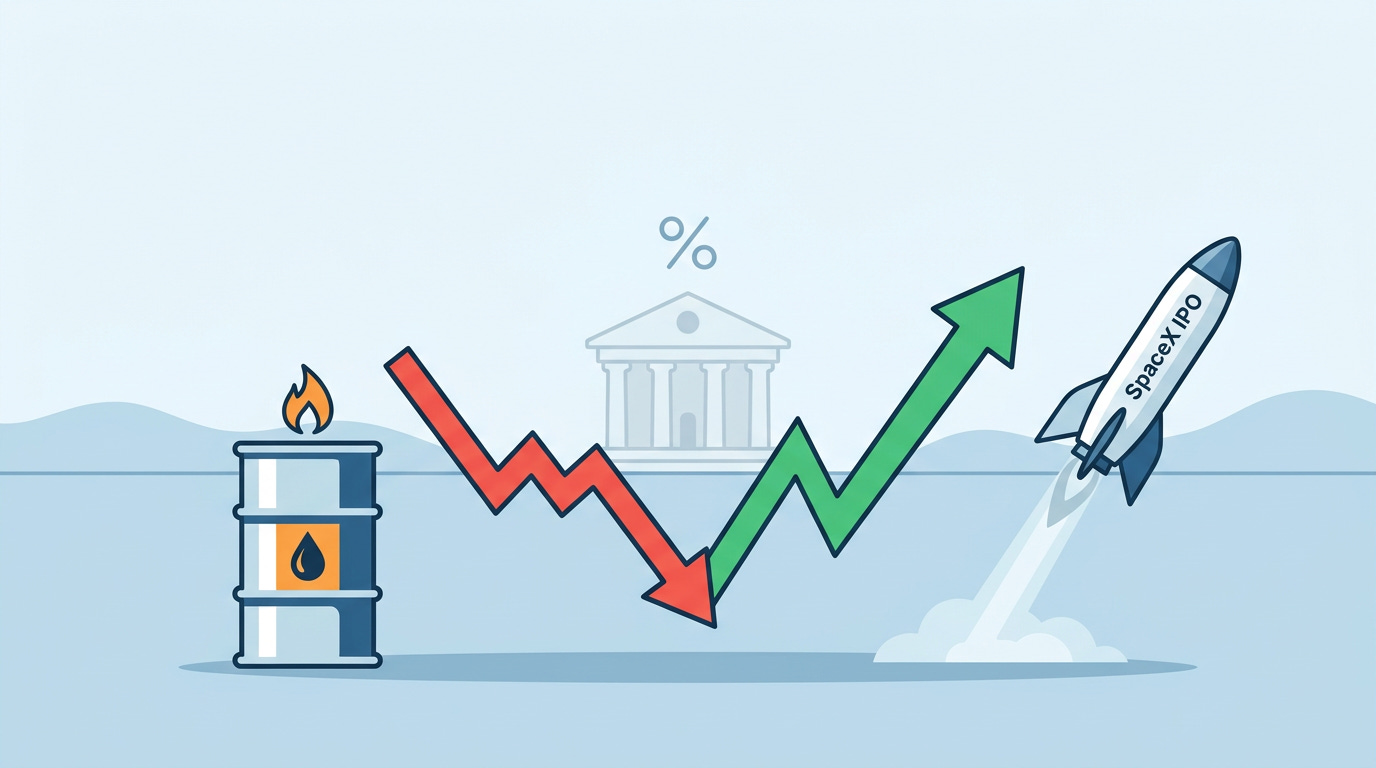
Global equities finally caught a break this week as Wall Street snapped a five-week losing streak, even as investors continued to wrestle with war headlines, expensive oil, and a “higher for longer” rate mindset. At the same time, a confidential IPO filing from SpaceX injected fresh excitement into risk assets, underscoring how AI and space remain the market’s defining growth narratives.
What is happening 📈
US stocks staged a broad relief rally. The S&P 500 rose about 3.4% for the week, while the Nasdaq Composite climbed roughly 4.4%, ending a five-week losing streak as hopes grew that the Iran war might de‑escalate and as earlier declines in oil prices helped sentiment. The Dow Jones Industrial Average also posted its first weekly gain in six weeks, rising close to 3%.
Volatility stayed elevated but directional pressure eased. After several weeks of heavy selling that pushed the Dow and Nasdaq into correction territory and left the S&P 500 roughly 9–10% below its late‑January high, this week’s move looked more like a bounce within an already volatile regime than a clean trend reversal. The VIX, Wall Street’s fear gauge, has been holding above 30, highlighting that geopolitical risk and rate uncertainty are still being priced aggressively.
Oil remains north of 100 and extremely headline‑driven. US benchmark crude has been trading above 100 dollars a barrel, its first sustained move above that level since the 2022 Ukraine shock, as the Iran war disrupts supply routes and risk premia stay embedded in energy markets. Over the year to date, oil prices have surged by roughly 75%, making energy the standout outperformer across major asset classes.
Gold and other defensive assets caught a bid. Gold prices climbed about 4% this week as investors sought hedges against both geopolitical shocks and the risk that inflation proves sticky. Treasuries saw modest yield declines as markets repriced the inflation and growth outlook, but yields remain materially higher than at the start of the easing cycle.
The Fed is firmly on hold, and markets are pricing fewer 2026 cuts. The Federal Reserve left the federal funds rate unchanged at 3.5–3.75% at its March meeting and signaled that uncertainty around the Middle East and inflation remains elevated. Futures and prediction markets now imply a very high probability that rates will be kept unchanged at the April 29 meeting and only one or even zero cuts over the whole of 2026, a sharp comedown from expectations earlier in the year.
Macro data are flashing stagflation risk. Recession‑probability models from several large forecasters have moved into the 30–50% range as growth indicators soften and the unemployment rate has ticked up toward the mid‑4s. At the same time, the spike in oil is expected to push key inflation gauges such as PCE back toward the mid‑3% range year-on-year, complicating any case for rapid rate cuts.
SpaceX quietly filed for what could be the largest IPO in history. On April 1, SpaceX confidentially filed for an initial public offering with US regulators, reportedly targeting a valuation of about 1.75 trillion dollars and testing the waters for a level above 2 trillion dollars. The deal could raise up to 75 billion dollars, eclipsing Saudi Aramco’s 2019 listing and making it the biggest IPO ever if priced near those levels.
The SpaceX story is really an AI and data‑infrastructure story. The proposed listing is expected to bundle Starlink (satellite internet), xAI (acquired in an all‑stock deal earlier this year), and X, the social network, into a single entity pitched as an orbital and AI data‑center powerhouse. Banks working on the IPO are reportedly being encouraged to buy subscriptions to the Grok AI chatbot, underlining how deeply AI services are being woven into the equity story.
Breadth and leadership remain unusual. Energy stocks have returned more than 40% year-to-date, massively outperforming the broader equity market and signaling how concentrated performance has become in commodities and value‑tilted sectors. Meanwhile, large‑cap growth and the “Mag 7” have come under sustained pressure as rising yields and profit‑taking weigh on long-duration tech names, even though parts of the AI complex still see strong capital expenditure and demand.
Why it matters 💡
The combination of a relief rally in equities and still‑elevated volatility suggests investors are not yet convinced that the macro shock from the Iran war and the oil spike has been fully priced in. With the S&P 500 still well below its highs and credit markets tightening at the margin, this looks more like a pause in a correction than the start of a new bull leg.
A higher‑for‑longer Fed in the face of rising energy‑driven inflation means real rates could stay restrictive even if headline inflation wobbles lower from month to month. That in turn keeps pressure on highly valued growth stocks whose cash flows are far out in the future and makes earnings quality, balance‑sheet strength, and pricing power more important drivers of returns.
The potentially record‑breaking SpaceX IPO is a reminder that public markets are still hungry for exposure to AI, space infrastructure, and new data platforms, even in a choppy macro environment. A successful listing at or near the rumored valuation would crystallize a huge amount of paper wealth, re-rate comps across space, satellite, and AI ecosystems, and potentially pull investor attention back toward high-growth stories at a time when the macro narrative is increasingly defensive.
At the same time, history shows that mega‑IPOs often mark sentiment extremes in a given theme or sector. The largest debuts of past cycles frequently arrived late in a bull phase, when private valuations were most stretched and public investors were willing to pay up for scale and narrative. That does not guarantee poor long‑term returns, but it does mean price discipline and understanding of underlying cash-flow drivers matter more than ever.
Opportunity 🎯
For long‑term investors, the current setup favors upgrading portfolio quality rather than making big directional bets on where the index trades next week.
Lean into balance‑sheet strength and durable cash flows. Companies with strong free-cash-flow generation, modest leverage, and genuine pricing power are better positioned if stagflation risks materialize and rates stay restrictive. In practice, that often means large, profitable firms in sectors like healthcare, select industrials, and certain parts of technology rather than unprofitable growth or highly levered cyclicals.
Treat energy as both opportunity and risk. The energy sector’s spectacular year‑to‑date outperformance reflects genuine cash-flow leverage to higher oil prices, but also leaves it more vulnerable if the conflict cools and crude retraces. Investors looking at energy exposure may want to think in terms of position sizing and time horizon—using the sector as a partial hedge against inflation and geopolitical shocks rather than an all‑in macro bet.
Look across regions, not just the US. Emerging markets like Korea and Taiwan have been relative winners this year as they benefit from AI‑related capital expenditure and diversified trade links. Selective exposure to markets with improving earnings revisions and less direct sensitivity to the Iran conflict could help diversify portfolios that are heavily concentrated in US mega‑caps.
AI and space remain structural themes—but entry price matters. The SpaceX filing underlines how AI, satellite connectivity, and data‑center infrastructure are converging into an investable theme that spans semiconductors, cloud providers, launch services, and ground-segment equipment. Rather than trying to guess the eventual IPO pricing, public‑market investors can focus on “picks and shovels”—the hardware, software, and infrastructure providers that enable AI and space applications across many end markets.
Use volatility intentionally, not reactively. With the VIX elevated and headlines driving intraday swings, this is an environment where disciplined rebalancing, staggered entry points, and—where appropriate and understood—options strategies can help manage risk and improve entry prices. For most investors, that means planning in advance how to respond to 5–10% pullbacks rather than trying to trade every headline.
Bottom line ✅
This week’s bounce is good news, but not an all‑clear: equities showed they can rally even as oil remains high and the Iran war grinds on, yet volatility, valuations, and the rate backdrop argue against complacency. The prospective SpaceX IPO crystallizes how powerful the AI‑plus‑infrastructure story has become, but it also raises familiar late‑cycle questions about how much future growth is already baked into prices.
For a long‑term investor, the playbook is to stay invested but selective—tilting toward quality balance sheets, resilient cash flows, and sensible valuations, while treating energy and AI/space exposure as risk‑managed allocations rather than story‑driven punts. In a market still ruled by geopolitics and policy expectations, time horizon and discipline are as important as stock picking.
Disclaimer: This article constitutes the author’s personal views and is for entertainment and educational purposes only. It is not to be construed as financial advice in any form. Please do your own research and seek advice from a qualified financial advisor. From time to time, I have positions in all or some of the mentioned stocks when publishing this article. This is a disclosure - not a recommendation to buy or sell stocks.