
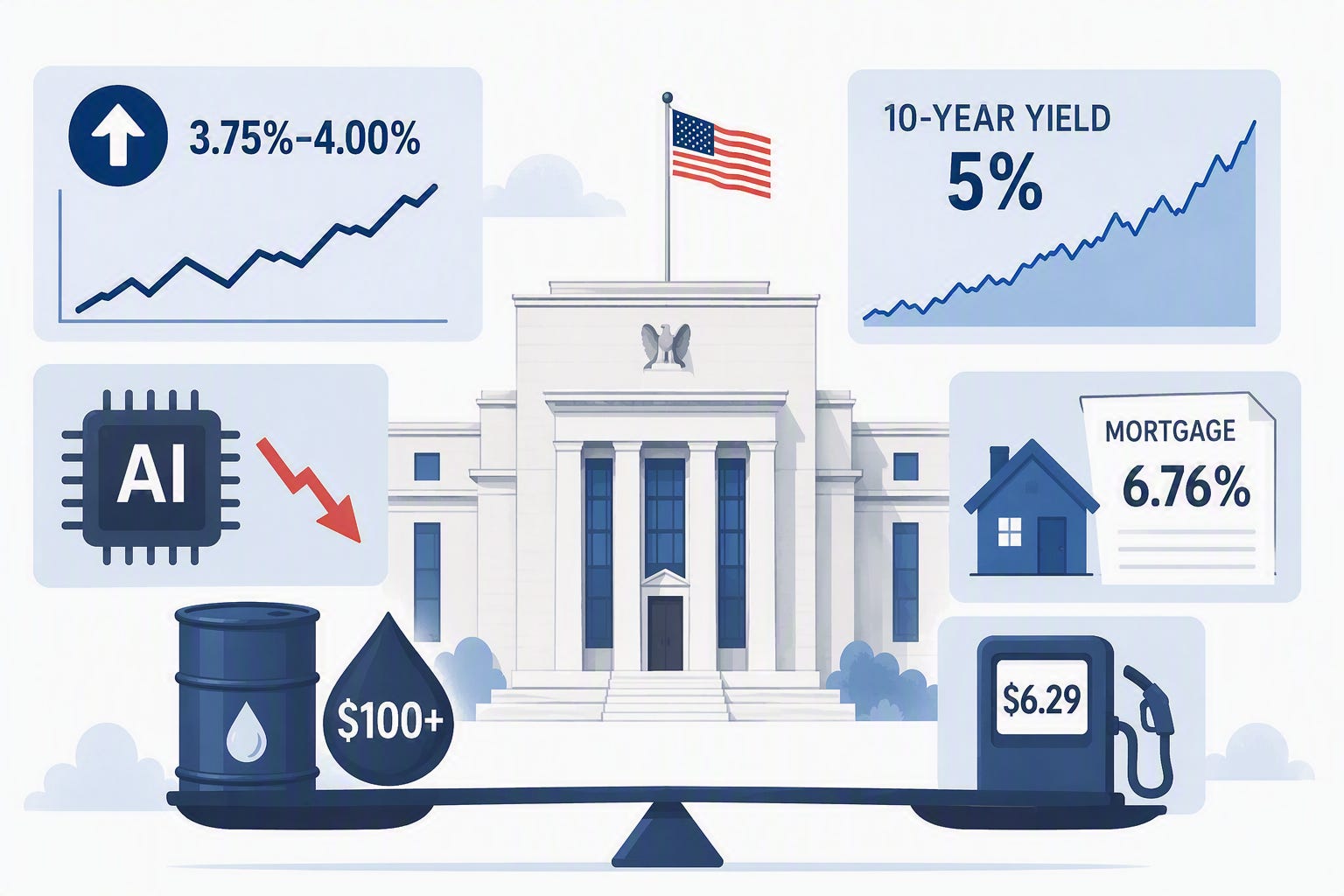
Remember last week, when we told you the Fed’s next move was basically a coin flip? Well, we have an answer, and it’s not the one most people were betting on back in August. On Wednesday, the Fed raised interest rates for the first time in three years. Two days earlier, some of the biggest names in AI stood up and said, essentially, “maybe we should slow down,” and chip stocks got hammered for it.
Oil stayed parked above $100 a barrel. The 10-year Treasury yield brushed up against 5%, a level it hasn’t touched in years. And somewhere in the middle of all that, Warren Buffett quietly handed over the keys to Berkshire Hathaway for good. It was a weird week to be an investor. A lot happened, and yet the S&P 500 ended up basically flat. Here’s what actually moved the needle, and why the calm on the surface is hiding more turbulence underneath.
📊 What’s happening
Let’s start with the main event. On Wednesday, the Federal Reserve raised its benchmark interest rate by a quarter point, pushing the target range to 3.75%-4.00%. It’s the first hike since 2023, and it flips the script on a debate that had dominated markets since late summer. Every member of the committee voted for it. Fed Chair Kevin Warsh didn’t sugarcoat why: “The plain fact is that inflation is too high and has been for too long,” he said, adding that this summer’s price data “do not tell me that underlying trends have meaningfully improved.” The Fed’s own projections now show most officials expecting one more hike before the year is out.
The timing was almost cruel. That same morning, August retail sales came in hot, up 1.2%, easily beating what economists expected. Strong spending is normally good news. But paired with a hawkish Fed and inflation that won’t cooperate, it read instead as evidence that the economy has too much momentum for rates to come down anytime soon. Markets wobbled on the news, found their footing Thursday, then slipped again Friday as bond yields kept climbing. By the end of the week, the 10-year Treasury yield was sitting right around 5%, its highest point in years, and the 2-year and 3-year both hit fresh 52-week highs. The average 30-year mortgage rate now sits at 6.76%. None of that shows up on a stock ticker, but it shows up on everyone’s monthly bill.
Then there’s the AI story, which started even before the Fed met. On Monday, Anthropic CEO Dario Amodei published an essay called “We Must Pace the Frontier,” arguing that AI labs should deliberately slow down how fast they build more powerful models. OpenAI’s Sam Altman backed him, and Elon Musk chimed in too, saying flatly that “Dario is right.” That’s not regulators or skeptics talking. It’s the people actually building the technology, and that’s what spooked a market that’s spent two years pricing in endless AI spending. The Philadelphia Semiconductor Index fell nearly 6% that Monday alone, with Nvidia down about 3.4%, Intel down 5.6%, and Micron off 7%. Chip stocks clawed back some of that ground by Friday, but the week left investors wondering whether the AI capex machine actually has a ceiling.
Put it all together and the week’s headline numbers look almost boring next to what drove them. The S&P 500 finished basically flat, down just 0.1%. Under the hood, though, it was messier: the Dow fell 1.7%, its worst week since March, dragged down by cyclical and small-cap names that have now declined for five straight weeks, while the Nasdaq gained 0.7% on that late-week bounce in tech and semiconductors. Oil held above $100 a barrel most of the week on the still-unresolved Middle East standoff we covered last week, and diesel hit a fresh record of $6.29 a gallon, up a staggering 68% from a year ago.
A few other things worth knowing: Netflix got downgraded on worries about its content lineup. Volkswagen slashed its profit forecast, blaming a tough Chinese market and restructuring costs. Apple’s new iPhone 18 hit stores with what early surveys call strong upgrade demand. Crypto-linked stocks jumped after the SEC offered more clarity on trading tokenized securities. And on a quieter note, drugmaker Xenon Pharmaceuticals lost 29% after pausing a late-stage epilepsy trial. Oh, and Warren Buffett, 96, officially stepped down as Berkshire Hathaway’s chairman, becoming chairman emeritus. His son Howard now holds the title, while Greg Abel continues running the company day to day.
🤔 Why it matters
A rate hike after years of cut talk is a bigger deal than the market’s muted reaction suggests. Higher rates mean higher borrowing costs everywhere: mortgages, car loans, business credit lines. Those costs usually take months to fully bite. The fact that the Fed felt it had to hike at all, even with growth cooling in other parts of the economy, tells you inflation has become the priority over everything else. That’s a real shift from the “cuts are coming” narrative that dominated most of this year.
The retail sales beat makes the Fed’s job harder, not easier. A resilient consumer is great for corporate earnings, but it also gives the Fed less cover to ease up, since strong spending can keep prices elevated. That’s the uncomfortable trade-off at the center of this whole cycle: good economic news and good market news aren’t always the same thing right now.
The AI slowdown call matters for a different reason. Much of this year’s market strength has rested on the assumption that AI infrastructure spending, chips, data centers, power, would keep growing without limit. When the people running the most influential AI labs start talking publicly about pumping the brakes, even for safety reasons rather than financial ones, investors have to ask whether that spending assumption still holds. Chip stocks bouncing back by Friday suggests most investors aren’t ready to abandon the trade yet, but the reflex sell-off shows how sensitive valuations have become to any hint of a ceiling.
💡 Opportunity
Keep watching the AI infrastructure trade, but treat this week as a stress test, not a verdict. The Monday selloff and Friday recovery both happened fast, which tells you sentiment here is jumpy. If you own chip or data center names, the next earnings season will matter more than any CEO essay.
Diesel at $6.29 a gallon is a cost that eventually shows up somewhere, trucking, shipping, groceries. Companies with thin margins and heavy logistics exposure are worth watching closely if oil stays elevated much longer.
Don’t read too much into one calm-looking index number. The S&P finishing flat hid a Dow that dropped sharply and a Nasdaq that climbed nicely. That kind of split is usually where the real opportunities, and the real risks, are hiding.
🎯 Bottom line
The Fed hiked rates for the first time since 2023, and the market’s muted response says more about how much uncertainty had already been priced in than about how comfortable anyone really is with where things stand. Between a hawkish Fed, a red-hot retail sales report, an AI industry publicly debating its own brakes, oil still stuck above $100, and Treasury yields brushing 5%, this was one of the more consequential weeks of the year dressed up as a quiet one. Watch how bond yields behave over the next few weeks. They’re doing more to shape markets right now than any single stock story, the AI one included.
Disclaimer: This article constitutes the author’s personal views and is for entertainment and educational purposes only. It is not to be construed as financial advice in any form. Please do your own research and seek advice from a qualified financial advisor. From time to time, I have positions in all or some of the mentioned stocks when publishing this article. This is a disclosure - not a recommendation to buy or sell stocks.