
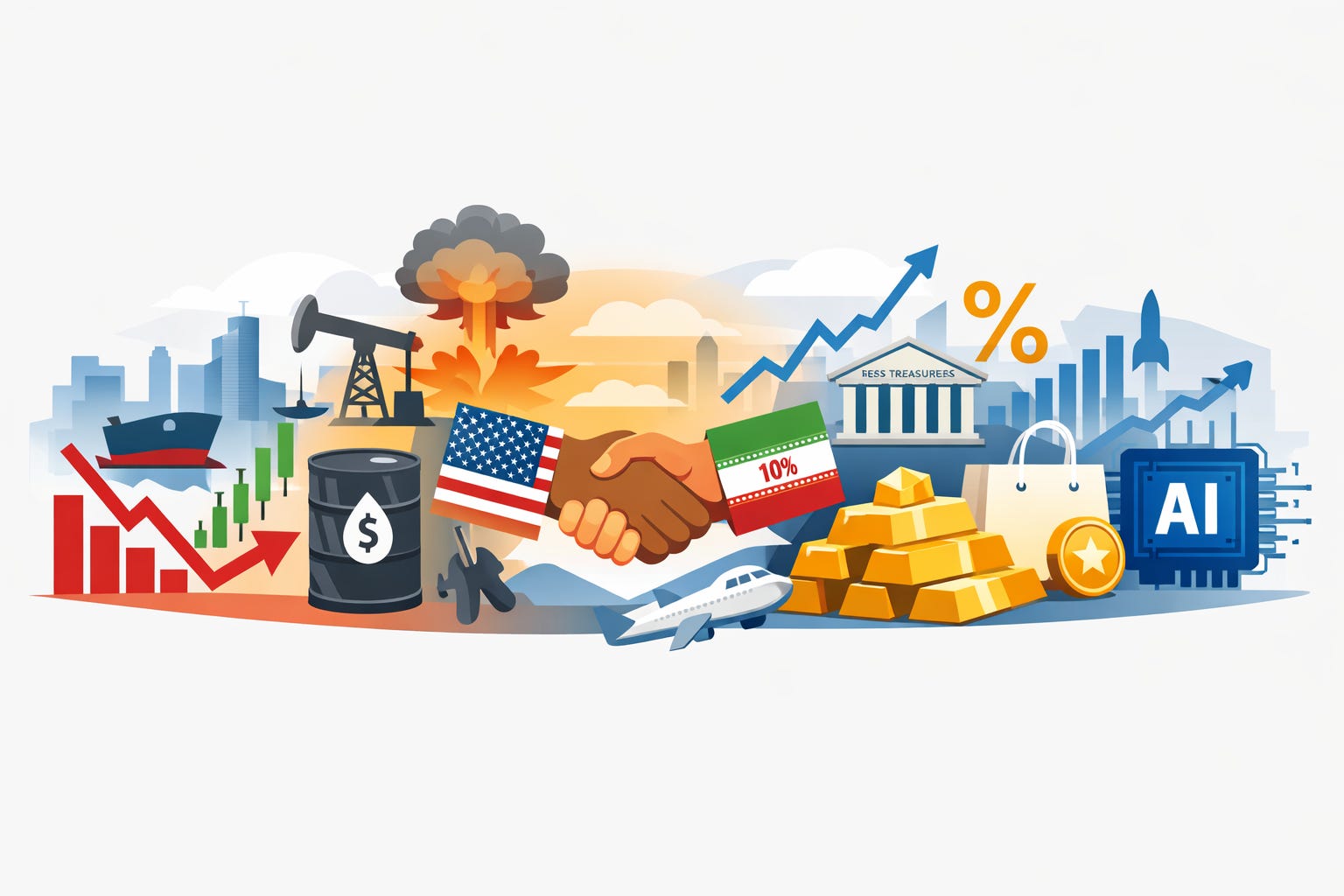
Global stocks just logged their strongest week of 2026 so far, powered by a fragile US‑Iran ceasefire, whipsawing oil prices, and a hotter‑than‑expected inflation print that kept bond markets on edge. Even after the bounce, major indices are still in the red year‑to‑date, so this feels more like a relief rally than a full‑blown trend change.
What’s happening 📰
Best weekly gains of the year (so far)
The S&P 500 is on track for about a 3.6% gain this week, its biggest weekly rise of 2026, with the Dow and Nasdaq also up more than 3% heading into Friday’s close. That follows last week’s move that snapped a five‑week losing streak for US stocks, marking a sharp shift from March’s drawdown.Ceasefire truce lifts risk assets
Markets rallied after the US and Iran agreed to a two‑week ceasefire and the reopening of the Strait of Hormuz, easing immediate fears over oil supply disruption. The ceasefire headlines triggered a global relief rally in equities, with travel and cyclicals bouncing, while energy names lagged.Oil whipsaws, energy stocks struggle
Crude prices plunged below 100 dollars a barrel after the ceasefire, before rebounding close to that level as fresh tensions and supply concerns resurfaced. That whiplash saw energy stocks underperform, while consumer discretionary and industrials were among the best‑performing sectors, and most S&P 500 sectors finished higher on the day.Inflation surprise keeps yields elevated
The latest US Consumer Price Index showed inflation running at about 3.3% year‑on‑year in March, the highest in roughly two years and above many expectations. The 10‑year US Treasury yield climbed to around 4.3%, as investors priced in the risk that the conflict‑driven energy shock could keep inflation sticky and delay any policy easing.Gold still a key safety valve
In the background, gold remains close to record territory above 5,100 dollars an ounce, after a surge earlier this year driven by geopolitical risk, central‑bank buying, and doubts about policy credibility. The metal is already up high‑teens percent year‑to‑date, reinforcing its role as the go‑to hedge when investors worry about both war and inflation.Early earnings and AI headlines support sentiment
On the micro side, early reporters like Levi Strauss beat earnings expectations with direct‑to‑consumer revenue growing in the mid‑teens year‑on‑year, hinting that pockets of consumer spending remain resilient. At the same time, Meta’s shares climbed around 2–3% after unveiling a new AI model, adding more fuel to the market’s favourite theme of the moment.
Why it matters 🤔
Relief rally ≠ all‑clear
A two‑week ceasefire is positive but temporary, and markets are effectively pricing in the hope that it evolves into something more durable. If talks break down or the Strait of Hormuz is disrupted again, oil could spike and risk assets may give back gains quickly.Growth vs inflation tug‑of‑war
The combination of stronger‑than‑expected inflation and higher long‑term yields tightens financial conditions even as stocks rally on better geopolitical headlines. That tension means investors are walking a fine line between “soft landing” optimism and “stagflation” fear, which can make market moves sharper in both directions.Leadership is shifting under the surface
With consumer discretionary, industrials and tech outperforming while energy lags, leadership has rotated away from the commodity‑and‑defensive mix that worked during the worst of the drawdown. Historically, these kinds of rotations often mark turning points in market narrative—from pure risk‑off to selective risk‑on.Safe‑haven demand hasn’t gone away
Even as equities bounce, gold’s surge to record levels and persistent demand from central banks show that big money is still hedging against policy missteps and geopolitical escalation. That mix of “risk assets up, hedges also up” is a classic sign that confidence is improving, but not fully restored.
Opportunity 💡
Lean into quality cyclicals, but keep duration in check
With consumer and industrial names leading the latest leg higher, investors looking for opportunities might focus on high‑quality cyclicals with strong balance sheets and pricing power, rather than the most leveraged plays on reopening or travel. The inflation backdrop and higher yields argue for avoiding overly long‑duration, profitless growth names that are more sensitive to rate repricing.Treat energy as a volatility trade, not a one‑way bet
The ceasefire‑driven sell‑off followed by a rebound in oil underscores that energy is now a geopolitical trading vehicle, not a simple macro bet. That lends itself more to tactical positioning (or options strategies) around clear catalysts than to “set‑and‑forget” exposure.Balance AI and defensiveness
AI‑linked winners like large‑cap tech and select chipmakers continue to benefit from strong sentiment and product headlines, as seen in moves around Meta and chip‑related names this week. Pairing that with defensive income plays or gold‑linked exposure can help smooth the ride if inflation or geopolitical risk flares up again.Watch early earnings for guidance, not just beats
Early reports—like Levi Strauss’ earnings beat and solid direct‑to‑consumer growth—suggest that parts of the consumer are holding up despite higher prices. The more important signal over the next few weeks will be management commentary on demand, margins, and pricing power as the earnings season ramps up.
Bottom line ✅
This week’s action looks like a classic relief rally: a ceasefire in a key conflict, a big bounce in risk assets, and a market eager to believe in a soft landing—even as inflation, yields, and gold all flash that the macro story isn’t fixed yet. For investors, the playbook is to participate selectively in the rebound—especially in quality cyclicals and AI‑beneficiaries—while keeping hedges and risk management front and center in case the ceasefire or inflation narrative turns.
Disclaimer: This article constitutes the author’s personal views and is for entertainment and educational purposes only. It is not to be construed as financial advice in any form. Please do your own research and seek advice from a qualified financial advisor. From time to time, I have positions in all or some of the mentioned stocks when publishing this article. This is a disclosure - not a recommendation to buy or sell stocks.