
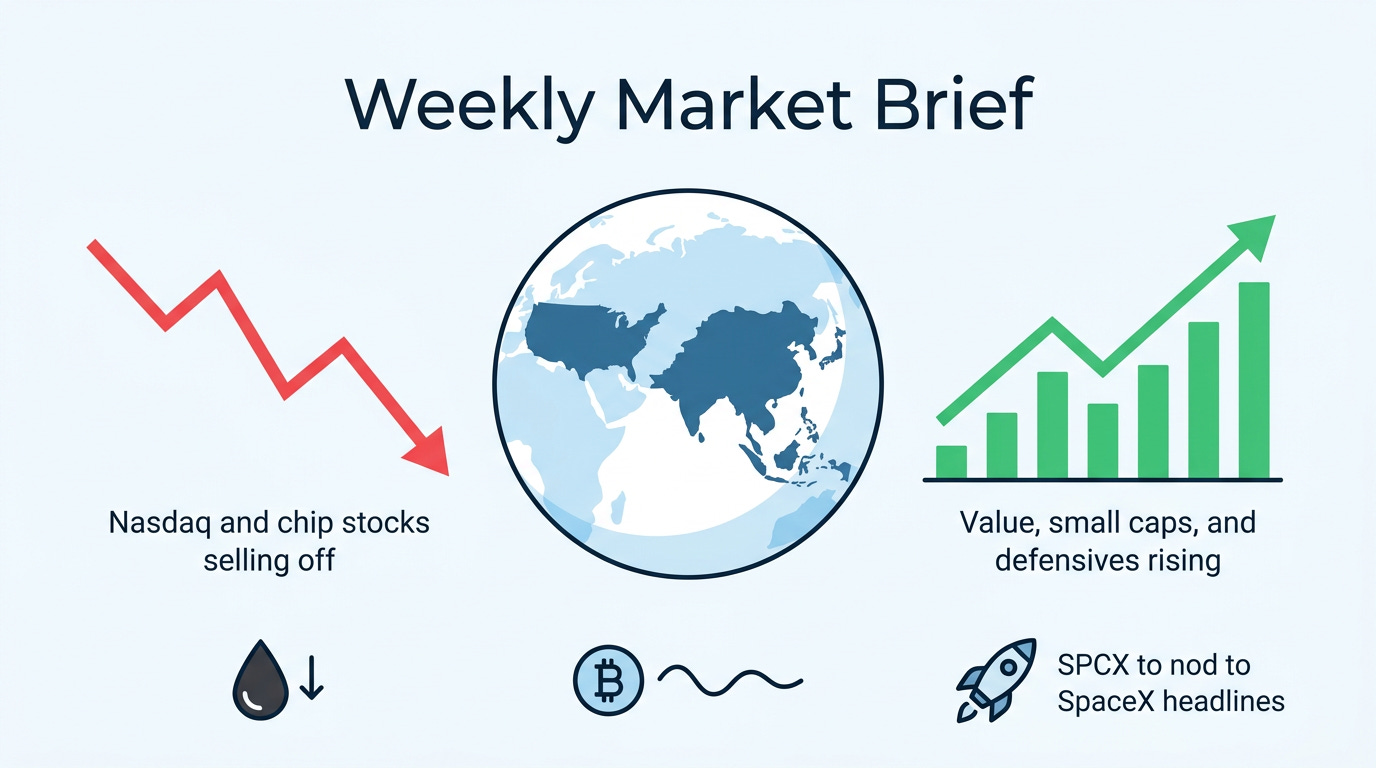
Tech finally hit the brakes this week, with the Nasdaq logging a drop of roughly 4–5% even as the Dow managed to finish slightly higher. At the same time, oil prices tumbled and Bitcoin slipped back below 60k, shifting the narrative from pure AI euphoria to one of sector rotation, inflation relief, and pockets of risk-off sentiment.
What is happening 📉
Big Tech & chips under pressure. The Nasdaq fell about 4.6% for the week, the S&P 500 dropped around 2%, while the Dow gained roughly 0.7%, as technology and semiconductor names led the selloff. Apple slid more than 5–6% after announcing price hikes on MacBooks and iPads tied to surging memory and storage costs, while Microsoft is suffering one of its worst June performances on record.
AI cost shock spreads to Asia. Apple and Microsoft’s price increases stoked fears that rising AI-driven component costs will curb demand, triggering a sharp slump in Asian tech: SK Hynix and Samsung each fell more than 10% at one point and the MSCI Asia Pacific Infotech index dropped about 6.4%.
Rotation under the surface. Despite headline weakness, value, equal‑weight, and small‑cap stocks showed relative strength: the Dow rose, the Russell 2000 climbed as much as 3.9%, and several defensive sectors outperformed.
Oil collapses toward pre‑war levels. WTI crude traded below 70 dollars per barrel, down roughly 9–10% on the week and nearly 25–40 dollars below recent 2026 peaks as shipping flows through the Strait of Hormuz normalized following a U.S.–Iran deal to reopen the route.
Crypto catches a cold. Bitcoin broke below 60,000, briefly trading near 59,500 and dropping more than 10% in 24 hours, with U.S. spot BTC ETFs seeing over 100 million in net outflows and roughly half of on‑chain supply now underwater.
Macro data still solid, but Fed cautious. U.S. PMIs stayed in expansion territory, Q1 GDP was revised up to 2.1% vs a 1.6% estimate, personal income and spending both rose 0.7%, jobless claims fell to 215,000, and PCE inflation printed about 4.1% year‑on‑year—keeping traders on edge as markets price in a possible rate hike by October even while lower oil eases headline inflation.
Why it matters 🎯
The AI trade is showing fatigue. After months of tech‑led gains, this week’s mega‑cap and chip selloff suggests investors are finally questioning how sustainable AI margins are once higher component costs hit consumer pricing. That’s pushing market leadership away from a narrow group of tech winners toward a broader mix of value, defensives, and small caps—reducing concentration risk but also raising volatility as leadership changes.
Oil’s slump is an inflation tailwind. Crude’s move back toward pre‑war levels and the reopening of the Strait of Hormuz relieve one of the biggest pressures on global inflation, supporting real incomes and corporate margins outside energy. For President Trump’s administration and other central banks, cheaper oil buys some breathing room, but sticky underlying inflation means policymakers are still hesitant to pivot away from a hawkish stance.
Risk appetite is normalizing, not collapsing. Bitcoin’s drawdown and ETF outflows show speculative risk is being trimmed at the margin, yet some institutional voices frame the move below 60k as a potential cycle bottom, not the start of a new “crypto winter.” Meanwhile, resilient U.S. growth and improving labor data argue against a hard landing narrative, even as higher‑for‑longer rates remain on the table.
Opportunity 💡
Rebalance away from crowded mega‑cap tech. With Big Tech under pressure and signs of exhaustion in the AI trade, this is an opportune moment to trim over‑weight exposure to the most crowded names and lean into more diversified allocations—large and mid‑cap U.S. equities, value, equal‑weight indices, and quality small caps that have been quietly outperforming.
Lean into sectors that benefit from cheaper oil. Lower energy prices are a direct tailwind for consumer, transport, and industrials, where fuel and logistics costs matter more than AI chip prices. Selective exposure to airlines, logistics, and consumer discretionary names with pricing power could offer upside if oil stabilizes near current levels and demand holds.
Use fixed income and cash tactically. Falling rate expectations have helped bonds rally, but with at least one Fed hike still priced in, staying short‑duration and high‑quality remains prudent rather than chasing long‑duration risk. For income‑focused investors, that argues for a mix of dividend stocks plus short‑term bonds, rather than betting everything on either tech growth or long‑dated yields.
Treat crypto as high‑beta risk, not core. Bitcoin’s drawdown reinforces that crypto behaves like levered risk assets—sensitive to liquidity, ETF flows, and macro shocks. Any allocation here should be sized like venture or high‑beta equity exposure, anchored to a clear thesis and risk budget rather than short‑term price targets.
Bottom line ✅
This week’s story is less about markets “breaking” and more about leadership rotating: tech and chips are digesting rich expectations, while value, defensives, and small caps quietly step up. With oil collapsing, crypto wobbling, and macro data still resilient, investors are being nudged toward portfolios that are more balanced across sectors and geographies, instead of betting everything on a handful of AI winners.
Disclaimer: This article constitutes the author’s personal views and is for entertainment and educational purposes only. It is not to be construed as financial advice in any form. Please do your own research and seek advice from a qualified financial advisor. From time to time, I have positions in all or some of the mentioned stocks when publishing this article. This is a disclosure - not a recommendation to buy or sell stocks.