
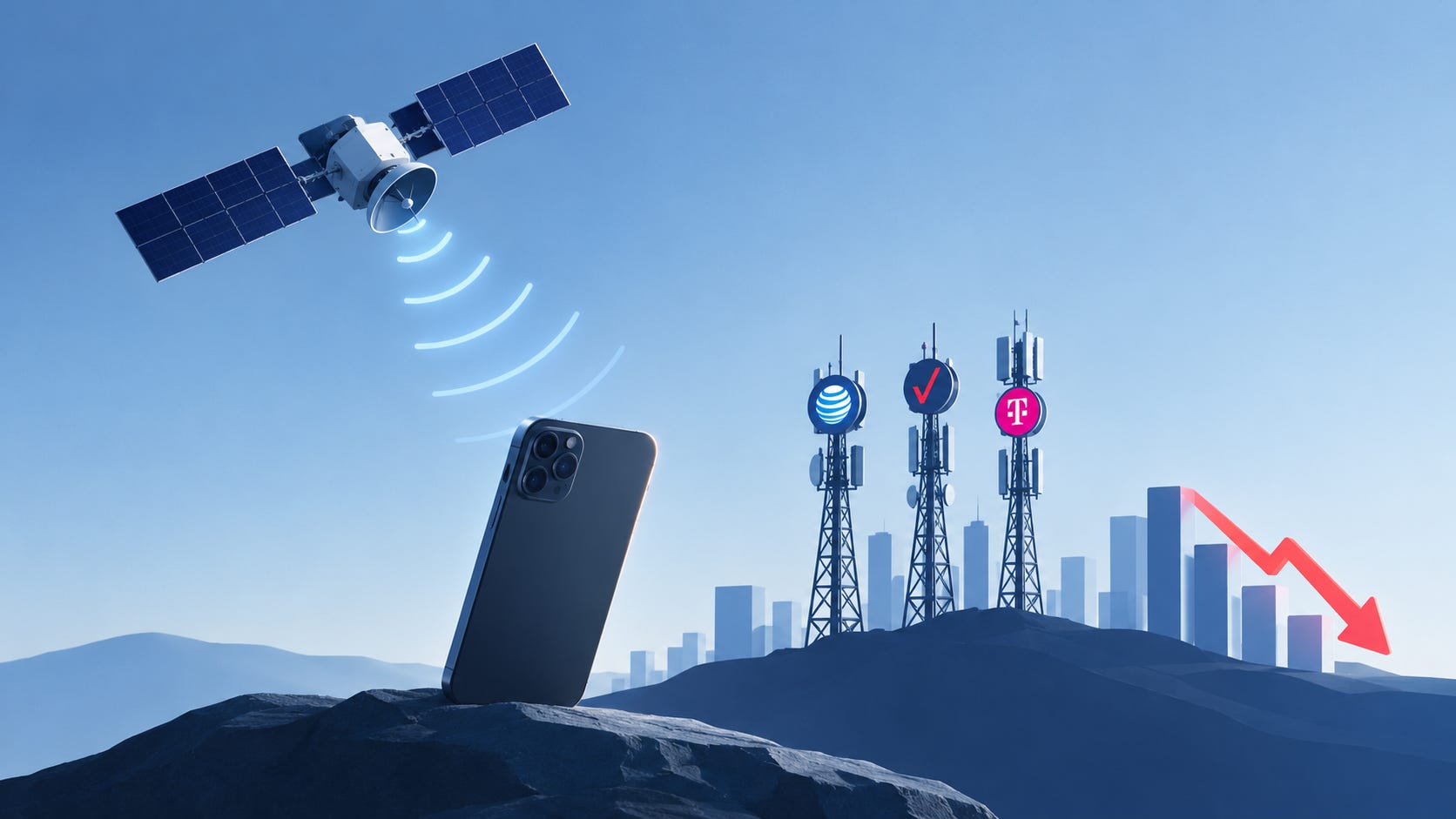
“Solving the last 2%.” That’s the line AT&T’s CEO keeps reaching for whenever satellite phone service comes up, the idea being it’s a nice-to-have for people who lose signal on a hiking trail, not a real threat to the business. His stock didn’t get the memo this week. AT&T, Verizon, and T-Mobile shed a combined $36 billion in market value after SpaceX agreed to spend $8 billion on spectrum that could let Starlink compete directly for your phone plan, not just your backup coverage. That was the headline-grabber, but it wasn’t the only thing moving markets.
The Fed released minutes showing officials still lean toward one more rate hike this year, Delta missed earnings and slashed its profit outlook on fuel costs, and an AI revenue scare hit stocks Thursday before fading by Friday. Through all of it, the big indexes still finished the week higher. Small caps didn’t.
📊 What’s happening
SpaceX is buying nationwide low-band spectrum, the 800 MHz band, from an investment firm called Grain Management, in a deal first reported by the Wall Street Journal and still waiting on FCC sign-off. The number that matters here is $8 billion in cash. Low-band spectrum travels farther and gets through walls better than the frequencies Starlink currently uses for satellite internet, which is exactly the gap SpaceX needs to close before satellite-to-phone service works indoors, not just in open fields. SpaceX says most existing phones should work with the new band without any hardware changes, though it’s unclear whether recent iPhones make the cut.
The market reaction was blunt. AT&T fell more than 6%, Verizon dropped over 7%, and T-Mobile slid nearly 7% as investors priced in a real competitive threat to the subscription business that funds those companies’ dividends. SpaceX stock rose on the news. The carriers’ CEOs pushed back hard: Verizon’s chief argued that physics will keep satellite from matching ground-based networks in cities and suburbs, while AT&T’s Stankey kept circling back to that “last 2%” line. Maybe they’re right. Satellite-to-phone is still a young technology, and SpaceX’s pitch has a habit of arriving a little ahead of what it can actually deliver at scale.
Away from telecom, the bigger macro story was the Fed. Minutes from the September meeting, where the Fed raised rates to 3.75%–4.00% in its first hike since 2023, showed most officials still expect to hike again before year-end to fight inflation that’s been running hot on tariffs and the oil shock from the Iran conflict. Futures markets now put the odds of a hike at the late-October meeting around 17%, but close to 70% for December. The 10-year Treasury yield sits near 5.25%, a 24-year high.
Delta kicked off earnings season Friday with a miss: adjusted profit of $1.72 a share against an expected $1.82, and full-year guidance cut from $6.50–$7.50 to $5.10–$5.60. The culprit was fuel, up 62% year-over-year and roughly $500 million above what Delta had guided to back in July.
Fuel keeps being the villain of this earnings season.
The one bright spot: Delta’s CFO said fare increases from earlier this year are sticking and demand hasn’t cracked.
AI had its own mini-scare. A Financial Times report Thursday pegged OpenAI’s actual annualized revenue run rate at around $50 billion in September, well below the $70 billion figure that had been circulating, and chip and AI infrastructure stocks wobbled on it. Bloomberg reported Friday that OpenAI still expects to hit $70 billion by year-end, and tech stocks mostly recovered the ground they lost.
For the week: the Dow gained 1.15%, the S&P 500 rose 0.95%, and the Nasdaq eked out 0.19%. The Russell 2000, loaded with smaller, more debt-dependent companies, fell 0.91% — the only major index in the red. Consumer sentiment slipped to a five-month low of 46.3 on cost-of-living complaints tied to gas prices and tariffs, gold pushed to a fresh record above $4,200 an ounce, and oil stayed elevated on both the Iran standoff and a hurricane that knocked out more than 60% of Gulf of America oil output for a few days.
🧩 Why it matters
Here’s the part that doesn’t add up at first glance: stocks near record highs, and borrowing costs at a 24-year high, at the same time. Usually one of those backs off. What’s actually happening is a split market. Large-cap indexes are being carried by a handful of companies with enough cash and pricing power that a 5.25% Treasury yield barely touches them, while smaller, more leveraged companies in the Russell 2000 are getting squeezed by exactly the financing costs the big names can shrug off. That gap is worth watching, because it tends to widen before it narrows.
The telecom story is a reminder that “safe,” dividend-paying utility-style stocks aren’t immune to disruption just because they’ve been boring for twenty years. I’ll say the quiet part out loud: I don’t think satellite phones replace cell towers anytime soon, but I also don’t love that three CEOs reached for nearly identical reassurances on the same day. That’s the kind of unanimous confidence that sometimes ages fine, and sometimes ages like Blockbuster’s.
And the Fed’s bind is the same one it’s been in for weeks: inflation from tariffs and oil hasn’t gone away, but the labor market has softened enough that another hike right now risks overcorrecting. December is when that tension gets resolved one way or the other.
💡 Opportunity
If you already hold AT&T, Verizon, or T-Mobile for the dividend, this week’s drop doesn’t change the underlying business overnight. The carriers’ argument about physics and indoor coverage is a real one, not just spin, and satellite-to-phone at true nationwide scale is still probably years away. That said, a genuine new competitor with $8 billion to spend and a direct line to launch its own satellites is not nothing, so this isn’t a moment to add to the position purely because it’s cheaper than it was Wednesday.
Airlines are trickier. Delta’s CFO insisting demand “hasn’t cracked” despite higher fares is a genuinely useful data point if you’re deciding between airline stocks: carriers with pricing power (premium cabins, loyalty programs, co-branded credit cards) are better positioned to pass fuel costs through than carriers competing purely on the cheapest seat.
Gold at a record high isn’t a new idea at this point, but if you’ve been holding some as a hedge against exactly this kind of environment, rates uncertain, inflation sticky, geopolitics ugly, this is the week it earned its place in the portfolio. And with December hike odds sitting near 70%, there’s less urgency to lock in today’s savings-account and CD rates than there was a few months ago, since the Fed clearly isn’t finished yet.
🎯 Bottom line
Three phone companies lost $36 billion in market value this week to a satellite company that didn’t exist as a publicly traded stock a year ago. That’s the kind of shift that’s supposed to take years, not forty-eight hours.
Disclaimer: This article constitutes the author’s personal views and is for entertainment and educational purposes only. It is not to be construed as financial advice in any form. Please do your own research and seek advice from a qualified financial advisor. From time to time, I have positions in all or some of the mentioned stocks when publishing this article. This is a disclosure - not a recommendation to buy or sell stocks.