
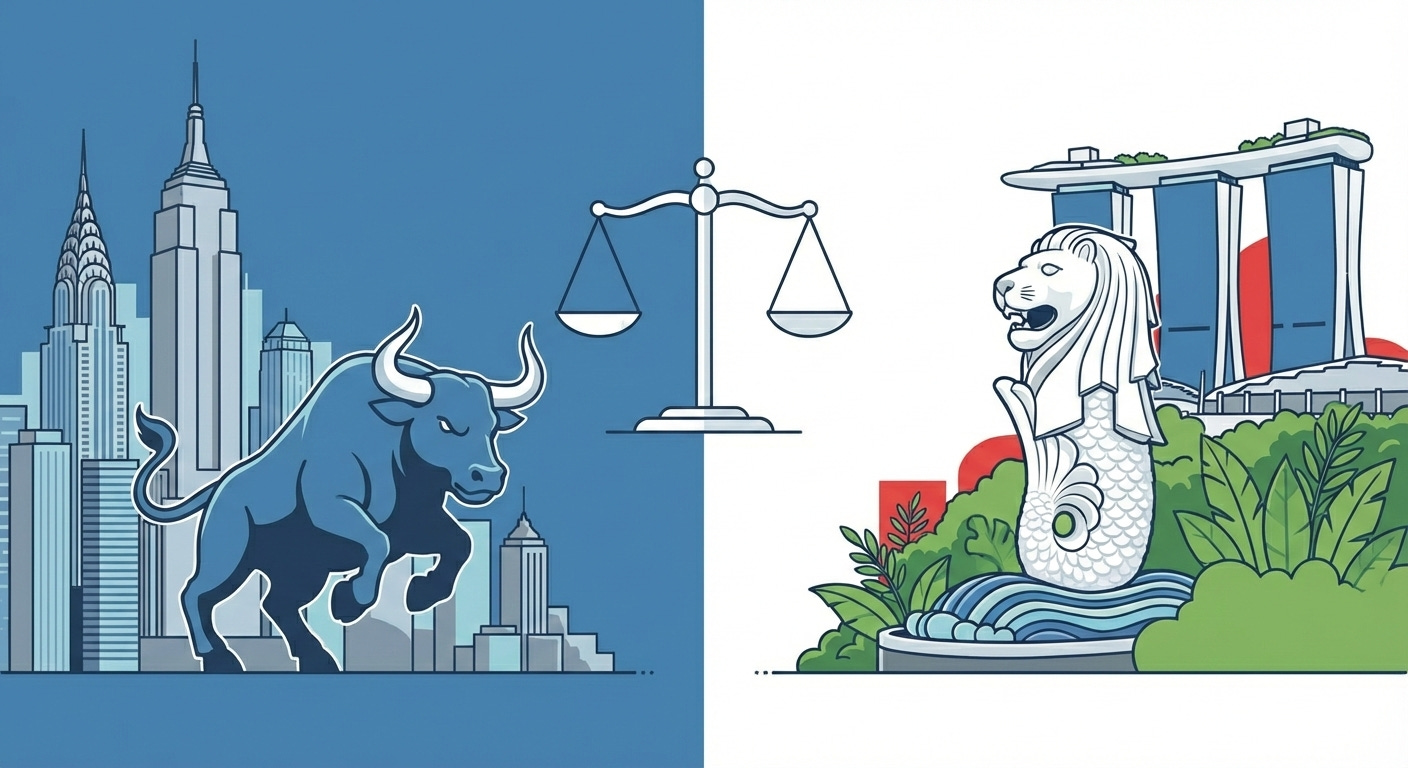
What’s going on here: You’ve hit a solid milestone: a fresh $10,000 in savings ready to be deployed. Now comes the classic tug-of-war for Singaporean investors. Do you stick with the tax-free, dividend-heavy comfort of the Singapore stocks? Or do you chase the high-octane, tech-fueled growth of the US market?
There’s no “right” answer, but there is a right answer for you. Here’s the breakdown.
The Home Ground Advantage (Singapore Stocks)
The Vibe: Steady, reliable, and boring (in a good way). Think of the Singapore market as your portfolio’s anchor. You generally won’t find the next Nvidia or Apple here, but you will find banks and REITs that act like rental properties—without the tenants calling you at 3 AM.
Why you’d pick it:
The Tax-Free Sweetener: This is the SGX’s superpower. Dividends in Singapore are tax-free. When DBS or a local REIT pays out, you keep every cent.
Currency Shield: Investing in SGD means you sleep soundly without worrying about the USD crashing against the SGD.
Stability: The STI is dominated by old-school sectors (Finance, Real Estate) that churn out cash regardless of whether AI takes over the world.
The catch: Growth is sluggish. If you’re looking for a stock that doubles in a year, you’re in the wrong neighbourhood.
👀 Opportunity: If you want cash flow to pay the bills, start here. Check out our SG Top Dividends List for the consistent yields right now.
The Growth Engine (US Market)
The Vibe: Fast, massive, and volatile. The US market is where innovation happens. It represents over 40% of the global equity market and is the only place to get serious exposure to Big Tech, AI, and global healthcare.
Why you’d pick it:
Capital Gains: This is the land of the “multi-bagger.” Companies like Microsoft and Apple offer growth trajectories that mature dividend stocks simply can’t match.
Global Reach: Buying the S&P 500 isn’t just buying America; it’s buying a slice of the global economy, given how international these companies’ revenues are.
The catch: Uncle Sam takes a cut. As a Singaporean, you face a 30% dividend withholding tax on US stocks. That means US dividend investing is inefficient—you’re here for the price to go up, not the payouts.
🚀 Opportunity: If you have a 10+ year horizon, you need this growth exposure. Check out our latest US Growth List for high-momentum picks.
The Verdict: How to Split the $10k
Your allocation depends on your “Financial Season.” Here are three ways to play it:
1. The “Cash Flow King” (70% SG / 30% US)
The Goal: You want passive income now.
The Play: Dump $7k into high-yield SG REITs/Banks to secure a ~5% yield. Put the remaining $3k into a broad US index fund just to hedge against inflation.
2. The “Growth Builder” (20% SG / 80% US)
The Goal: You’re young (or patient) and don’t need the money for a decade.
The Play: Go heavy on the US. Put $8k into growth stocks or tech ETFs. Keep $2k in SG stocks purely as a defensive buffer or “dry powder.”
3. The “Sleep Well at Night” (50% / 50%)
The Goal: Balance.
The Play: Split it down the middle. Use your SG dividends to fund your future US growth purchases.
💡 The Takeaway
You don’t have to choose sides. The healthiest portfolios usually have both: a Singaporean engine to generate cash flow, and an American engine to build wealth. Look at your current holdings—if you’re heavy on tech, buy some boring SG banks. If you’re drowning in REITs, it’s time to look West.
Sign up now and get our free REITs’ Numerical Ratings.
Disclaimer: This article constitutes the author’s personal views and is for entertainment and educational purposes only. It is not to be construed as financial advice in any form. Please do your own research and seek advice from a qualified financial advisor. From time to time, I have positions in all or some of the mentioned stocks when publishing this article. This is a disclosure - not a recommendation to buy or sell stocks.
Didn't expect such a briliant breakdown of the Singapore market's appeal, especialy the tax-free aspect is a significant pull. I'm wondering, given the 'sluggish growth' you mentioned, if there's a threshold where the consistent, tax-free dividends from SGX still outperform the higher-growth US stocks over a very long horizon, factoring in currency shifts for non-SGD investors like myself.